
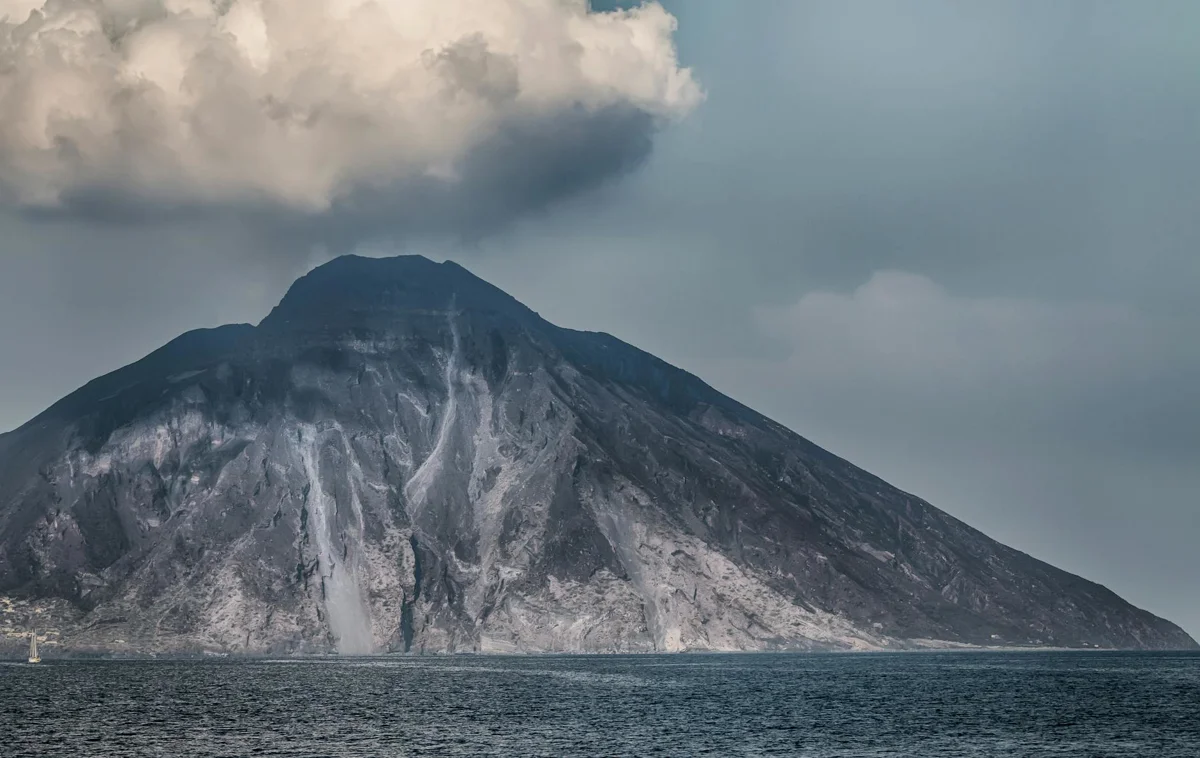
The Aeolian Islands, off northern Sicily, are the only place in Europe where divers can descend onto active volcanic terrain. Hydrothermal vents push sulfur bubbles from 8 m depth, geothermal heat warms the water well above Mediterranean norms, and Roman wrecks loaded with amphoras have rested on the same sandy patches for 2,000 years. A niche destination where geology, archaeology and wall diving converge.
Seven volcanic islands — Lipari, Salina, Vulcano, Stromboli, Panarea, Filicudi, Alicudi — form the Aeolian archipelago, a UNESCO World Heritage Site since 2000. Stromboli has erupted almost without pause for 2,000 years; much of that volcanic activity extends below the waterline. Around Vulcano and Panarea the seafloor is riddled with active fumaroles: gas vents pushing columns of bubbles at temperatures up to 100 °C. Hovering at 10 m above one of them is a geological event, not a wildlife encounter.
The signature dives cluster around Panarea: Le Formiche, a scatter of volcanic pinnacles draped in fumaroles; il Bottaro, a submerged volcanic cone with unusually dense fauna; and Capo Vulcano on the island's south side. Off Vulcano itself, the Faraglione di Vulcano sector holds the most dramatic hydrothermal vents, though they sit deeper. Depths range from 10 to 35 m depending on the route. Visibility holds at 20–30 m, and summer water temperatures reach 23–26 °C — noticeably warmer than anywhere else in the central Mediterranean at this latitude.
Roman wrecks: the Aeolians sat astride the main commercial lanes of the central Mediterranean in antiquity. Dozens of wrecks have been catalogued, several within recreational diving range. The most visited is the Roghi, lying at 35 m off Lipari — a 1st-century merchant vessel whose amphoras still lie scattered across the sand roughly as they settled. Access is regulated: only dive centres holding a permit from the Soprintendenza del Mare may guide divers here. Wreck protocol is strict — no touching, no collecting fragments, no fanning the sediment.
Marine life: the mix of warm, nutrient-rich water produces biodiversity above the Mediterranean average. Large groupers, dentex, oversized sargo bream, seasonal schools of bonito and swordfish are all present. Pelagics pass through Stromboli on migration routes. Red gorgonian fans grow thick on walls below 30–40 m. Wildlife is not the headline act at the Aeolians, but the baseline is solid.
Getting there: fly into Catania or Palermo, drive or transfer to Milazzo — the main departure port — then take a 2–3 hour ferry to Lipari, the best-connected island. Smaller inter-island ferries link the rest. Lipari has the widest range of accommodation, starting around €70 for a double room. Dive centres operate on Lipari, Vulcano and Panarea. Prices are reasonable: €45–60 for a guided dive, €240–280 for a block of six. English is widely spoken at the main centres; German is common too.
Season: water sits at 16 °C in April and peaks at 26 °C in August. June and September are the sweet spot — water at 22–25 °C, tourist crowds manageable. July and August push prices roughly 30 % higher. Most centres scale back sharply in winter. The pelagic window for bonito and swordfish runs August through September.
The frustration: inter-island logistics. Combining dives at Vulcano and Panarea means coordinating ferry schedules — short crossings, but planning is required. Some centres operate from a single island and lack a fast boat to take you elsewhere. A week split between two islands extracts the most value; a week on Lipari alone leaves gaps. Three-day visitors rarely see enough to justify the journey.
The Aeolian Islands are not trying to be Malta or the Red Sea. They draw divers who have already ticked off the standard Mediterranean circuit and want terrain that is geologically active, archaeologically layered, and relatively uncrowded. For a fifth or sixth Mediterranean dive trip, the Aeolians reward curiosity. For a first dive holiday, easier options exist.