
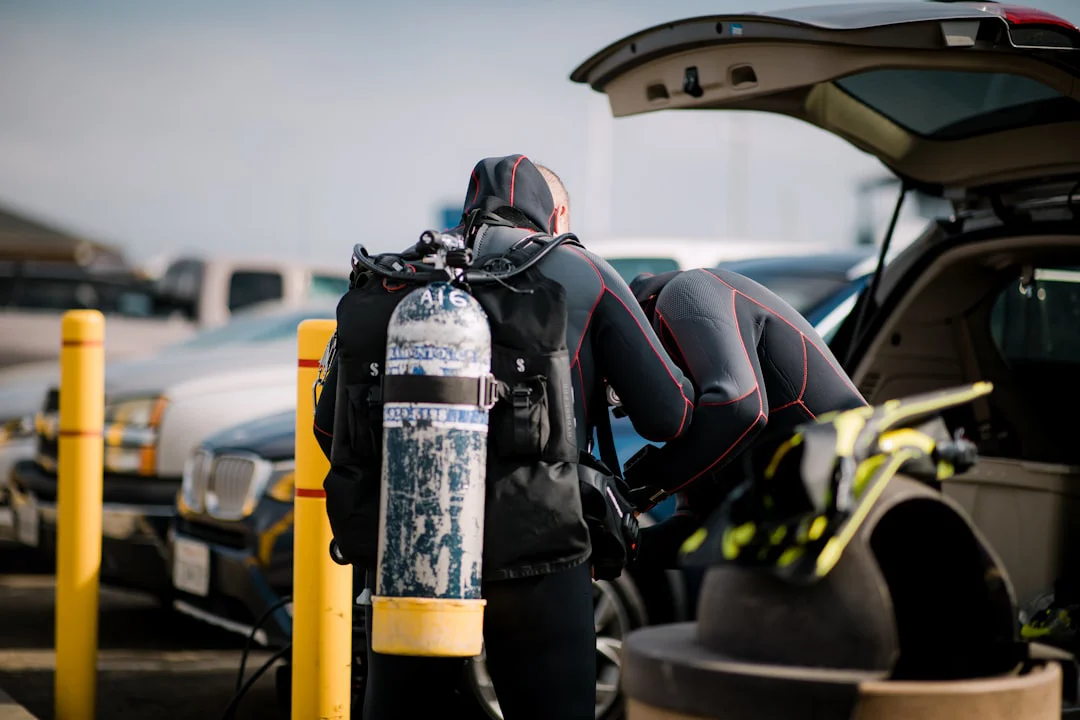
Travel BCDs are built to cut weight and bulk for air travel. They tip the scales at 1.5–2.5 kg versus 3–5 kg for a standard BCD. For divers who fly to remote destinations with their own kit, the investment makes sense — but understanding the trade-offs matters before buying.
A standard BCD weighs 3–5 kg empty and eats up 30–40 % of your dive bag. A travel BCD comes in at 1.5–2.5 kg — 40–50 % lighter — and occupies just 15–20 % of the same space. On budget carriers or domestic routes in Indonesia and the Philippines, that gap can mean the difference between a 100 € overweight fee and sailing through check-in without a problem.
Popular models: 1) Aqualung Zuma (1.8 kg, 250–350 €) — the segment benchmark. 2) Mares Pure Trim (2.2 kg, 350–450 €) — modular with removable pockets. 3) Cressi Travelight (2.0 kg, 250–350 €) — strong value for money. 4) Scubapro X-Black ProDive (2.5 kg, 400–500 €) — hybrid travel/recreational crossover. All fit comfortably within standard airline limits (one checked bag at 23 kg).
What you give up: 1) Pockets — travel BCDs typically offer 1–2 integrated pockets versus 3–4 on a standard vest. 2) Durability — lighter Cordura fabrics wear faster under intensive use than the heavier weaves found on full-size BCD. 3) Integrated weights — many travel BCDs lack a proper integrated weight system or carry a reduced version. 4) Lift capacity — usually 12–16 kg versus 18–22 kg on a standard BCD; fine for recreational diving, restrictive for technical work.
What you gain: 1) Travel weight — 1.5–2.5 kg back in your luggage allowance. 2) Volume — it can fit in cabin baggage when needed. 3) Comfort — many divers report less bulk around the torso makes positioning easier. 4) No price premium — saving weight generally does not cost more than a comparable standard BCD. 5) Full recreational capability — every standard recreational dive requirement is met.
When a travel BCD makes sense: 1) If you take 2+ dive trips a year to distant destinations. 2) If your current BCD dominates your luggage. 3) If the budget allows for two BCDs — one local, one travel. 4) If your diving is recreational rather than technical or cold-water. A diver who only dives locally is better served by a standard BCD.
Common mistakes: 1) Buying one that is too small — it will not fit over a thick wetsuit; always try it with your full kit. 2) Using a travel BCD for technical diving — the lift capacity is not there. 3) Expecting the same service life as a standard BCD — lighter fabrics degrade faster under regular use. 4) Forgetting that separate weights are needed when the travel BCD has no integrated system.
Which model to choose depends on priorities. Best value: Cressi Travelight. Best quality and reliability: Aqualung Zuma. Maximum modularity: Mares Pure Trim. Best versatility for mixed travel and local use: Scubapro X-Black ProDive — heavier but more adaptable.
The bottom line: a travel BCD earns its place for divers who fly frequently to destinations where excess-baggage costs add up. Spending 250–500 € to shed 1.5–2.5 kg per trip pays off quickly over five or more years of regular travel. For local divers with no flights, it solves a problem they do not have. The simple test: if your standard BCD works and you are not boarding planes with it, skip it; if you are taking 2+ annual dive trips, it warrants serious consideration.