
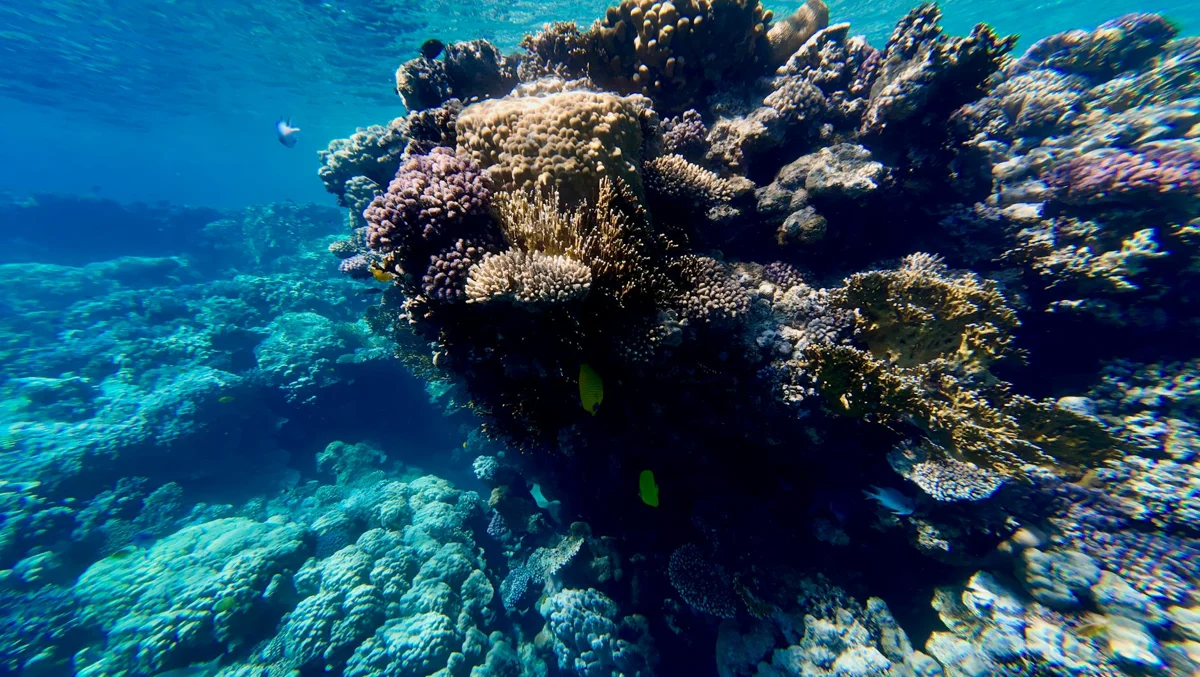
Eilat is Israel's only access to the Red Sea, at the northern tip of the Gulf of Aqaba, across from Aqaba (Jordan) and north of Sinai (Egypt). The destination has 11 km of coastline with coral reefs protected as a nature reserve, Dolphin Reef, and a diving programme for people with disabilities. It is a convenient option from Europe with cheap direct flights.
Eilat is Israel's southernmost city, sitting at the very top of the Gulf of Aqaba (Red Sea), wedged between the Jordanian border to the east and the Egyptian border to the west. Just 11 km of coastline, yet dense with tourism: 50,000 residents and over 2 million visitors a year. The city is a tax-free zone — cheap flights from Europe (easyJet, Ryanair, Wizz Air), accommodation from €60, budget gear rentals.
Underwater geography: the Gulf of Aqaba is the deepest rift in the Red Sea (1,850 m at its centre). Coral walls drop steeply from shore. Water temperature in Eilat ranges from 21 °C in February to 26 °C in August. Average visibility is 20–30 m, slightly less than in Aqaba (Jordan) due to higher tourist traffic and dredging. The reef has been protected as the Eilat Coral Beach Nature Reserve since 1964.
Main dive sites: 1) Coral Beach Reserve (paid entry, 25 ILS, main reef with walls and coral garden, 5–30 m). 2) Dolphin Reef (natural enclosure with semi-captive bottlenose dolphins, guided dives possible). 3) Japanese Gardens (coral garden south of the reserve, 12–20 m). 4) Caves Reef (caves and arches, 10–25 m). 5) Satil Wreck (military torpedo boat sunk in 1994, 22 m). 6) Tables (extensive tabular Acropora). 7) Light House (15–30 m depth range).
Accessible diving: Eilat is one of the world's most advanced destinations for adaptive diving. Centres such as Aqua Sport and Lucky Divers run programmes for paraplegics, amputees, people with Down syndrome and visual impairments. Adapted equipment, HSA-certified instructors (Handicapped Scuba Association) and water-entry ramps. A global reference alongside Cozumel and Florida Keys.
Logistics and costs: direct flights from Madrid, Rome, Paris, Berlin and London (Wizz Air, easyJet, Ryanair from €80–150 return). Varied accommodation: hostels from €30, chain hotels €80–200. Established dive centres: Aqua Sport, Lucky Divers, Manta Diving Center, Snuba Eilat. Per-dive cost: €30–40 shore diving, €45–60 boat diving. Five-dive package: €150–200. No visa required for Europeans (90 days visa-free).
The Dolphin Reef programme: the site keeps a colony of 8 bottlenose dolphins in a natural enclosed bay — not a pool. The dolphins can leave to the open sea freely but tend to stay for the feedings. Dolphin dive programme (€140–180 per session, two guided dives). It draws criticism from an animal-welfare standpoint, but it is an operational reality of the destination. A more ethical alternative: wild dolphin encounters in Egypt (Sataya, Marsa Alam).
What disappoints: the crowds at Coral Beach. The reserve draws thousands of swimmers daily in summer and coral quality has declined over the past 30 years. Shallow corals (5–10 m) show bleaching and physical damage from sunscreen and contact. Pelagic life is sparse — sharks and rays are rare. For a less crowded coral experience, Aqaba (Jordan, 15 km away) has healthier reef and lower prices. The price gap between Eilat and Aqaba can be 30–40% in Aqaba's favour.
The bottom line: Eilat is a convenient Red Sea gateway from Europe with cheap flights and varied accommodation. Adaptive diving is a world reference. Coral is decent but tourist-degraded. For lower prices and better reef, the Aqaba border crossing is 15 minutes away. As a dedicated dive destination, Egypt and other Red Sea options are stronger. Eilat works well as a city-break-with-diving combo, not as a serious single-purpose dive trip.