
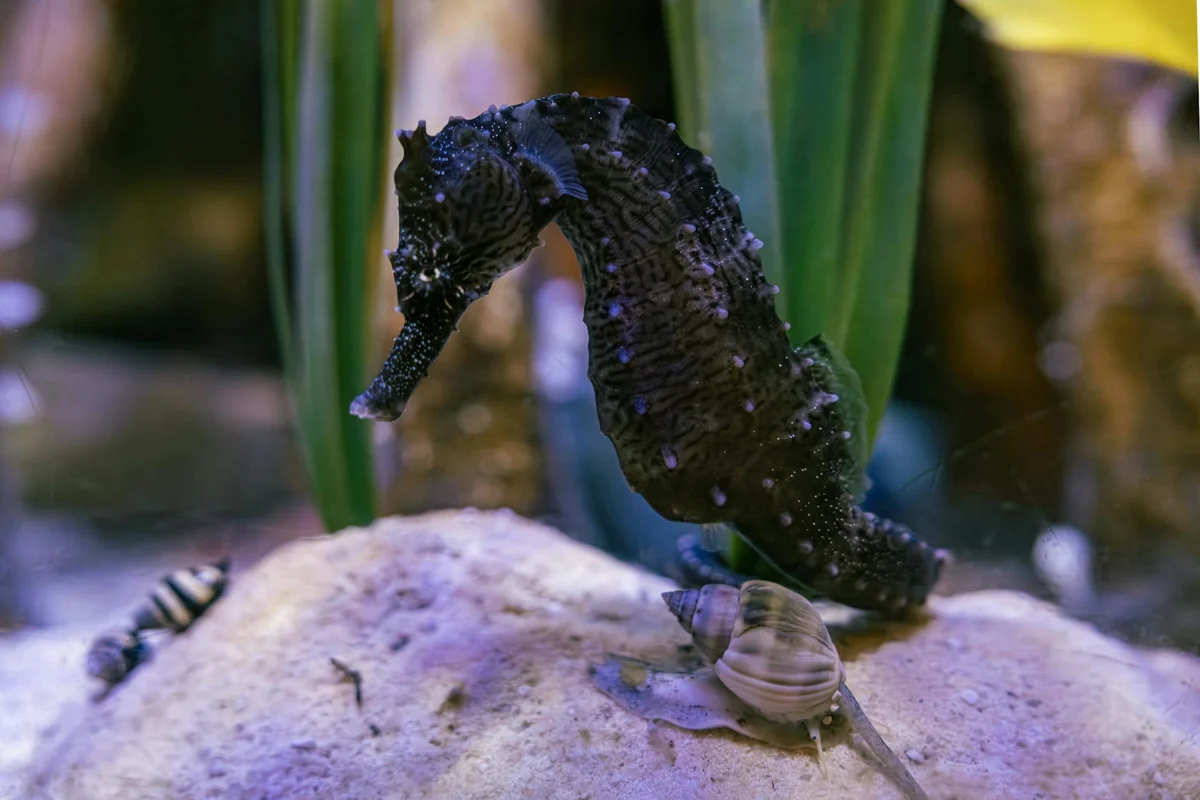
Seahorses (genus *Hippocampus*) are the only animals in the kingdom where males carry the pregnancy and deliver the young. There are 47 documented species across tropical and temperate waters. Global populations have dropped by 30–50% over 30 years, driven by seagrass destruction and the dried-seahorse trade for traditional Chinese medicine. For macro divers, they remain one of the ultimate targets.
Seahorses are bony fish of the genus *Hippocampus*, within the family Syngnathidae — which also includes pipefish. Forty-seven species have been described, ranging from 13 mm (*Hippocampus denise*, a pygmy seahorse) to 35 cm (*Hippocampus abdominalis*, the big-belly seahorse of Australia). Their body plan is unmistakable: horse-like head, elongated neck, S-curved trunk, a prehensile tail for anchoring to vegetation, and bony plates instead of scales.
Reproduction works like this: the female deposits eggs into the male's brood pouch during courtship, which can last several hours and involves elaborate synchronized swimming. The embryos develop inside that pouch for 9–45 days depending on species. Birth is genuine — the male expels the young through muscular contractions, releasing anywhere from 100 to 1,500 juveniles in a single event. No other vertebrate carries and delivers offspring this way.
Population collapse has been steep: global numbers have fallen 30–50% over the last 30 years. Four main drivers account for the loss. Seagrass destruction — posidonia meadows in the Mediterráneo, mangroves across Asia, zostera beds in the Atlantic — strips away the habitat seahorses depend on. The dried-seahorse trade for traditional Chinese medicine moves up to 150 million animals per year. The ornamental aquarium trade adds pressure through live capture. Climate change and ocean acidification compound all of the above.
The species macro divers seek most: *Hippocampus bargibanti* (Bargibant's pygmy seahorse, 13–27 mm, found only on Muricella gorgonians in the Indo-Pacífico) is the crown jewel. *Hippocampus denise* is even smaller at 13–15 mm and shares the gorgonian habitat. *Hippocampus pontohi* (Pontoh's pygmy seahorse) turns up on algae and hydroids. *Hippocampus guttulatus* (the long-snouted seahorse, around 12 cm) inhabits posidonia in the Mediterráneo. *Hippocampus abdominalis* reaches 35 cm in the cold waters of Australia and Nueva Zelanda.
For destination planning, Indonesia stands apart. Lembeh Strait, Bali, and Raja Ampat collectively hold the highest pygmy seahorse diversity on the planet. Filipinas — particularly Anilao and Cebu — runs a close second. In the Mediterráneo, Cataluña, Mallorca, Italia, and Croacia still support residual *H. guttulatus* populations in posidonia meadows, though sightings have thinned considerably. The cold Atlantic coasts of Galicia and Bretaña hold *H. hippocampus* in shallower rocky habitat. Southern Australia and Tasmania are the place for large-bodied big-belly seahorses.
Finding pygmy seahorses requires a local guide who knows which specific gorgonian each animal calls home — pygmies spend their entire lives on a single coral. For Mediterranean species, slow passes over posidonia between 5–15 m, scanning leaves and holdfasts, produce the most sightings. Night dives improve encounter rates for several species. Patience matters more than technique: seahorses move little, but their camouflage is remarkably effective.
Macro photography of seahorses rewards the methodical approach. For pygmies, a 90–105 mm macro lens fitted with a diopter, a strobe with diffuser, and precise autofocus are the baseline kit. Intermediate-sized species work well with a 60–90 mm lens and a single direct strobe. Three rules that protect the animal: never make physical contact, avoid sustained direct light — it stresses them — and keep the front element at least 5 cm from a pygmy's body.
The picture that emerges is of an animal simultaneously extraordinary and precarious. The inverted pregnancy, the camouflage refined to the level of a single gorgonian colony, the near-motionless patience — all of it earned over millions of years of evolution. The trade and habitat loss happening now operate on a timescale those adaptations cannot match. Citizen science platforms that log seahorse sightings from divers are producing the population data that researchers otherwise cannot gather at scale.