
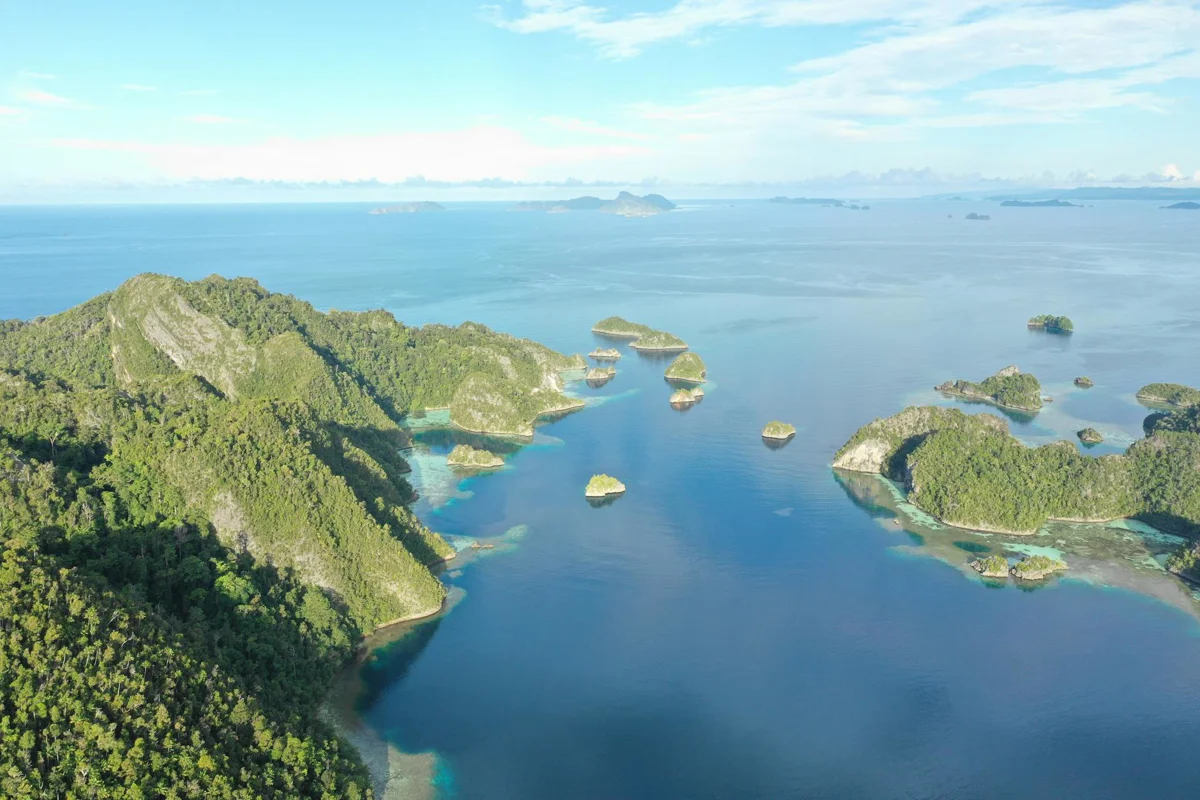
Raja Ampat tops every list as the world's marine biodiversity hotspot. The claim sounds like marketing copy until you look at the data: 1,700 fish species, 600 hard coral species (75% of the global total), every major family of marine fauna represented. Science backs it up, and every dive confirms it.
Raja Ampat is an archipelago of 1,500 islands in Indonesia's West Papua province, sitting off the tip of New Guinea's Bird's Head Peninsula. The four main islands—Waigeo, Misool, Salawati and Batanta—frame a seascape that Conservation International surveys (2002–present) consistently rank as the most biodiverse corner of the Coral Triangle, itself the most biodiverse marine region on earth. The density of life underwater has to be seen to be believed.
The numbers are staggering. More than 1,700 fish species—more than the entire Caribbean combined. Over 600 hard coral species, representing 75% of the world total. Every major shark family except the great white, 25-plus manta ray species, and healthy populations of turtles, dugongs, cetaceans and rare rays. A single 60-minute dive at Misool regularly turns up 200-plus distinct species. The Caribbean as a whole has fewer.
Two main zones define the diving. The north, centred on Waigeo and Wayag, has stronger currents, more pelagic action—reef and oceanic mantas, sharks—and the famous mushroom-shaped karst islands. The south, centred on Misool, offers richer coral diversity, superb macro life and calmer water. Macro photography and wide-angle coral portraits: go south. Drift dives with pelagic encounters: go north. Each zone rewards a dedicated itinerary.
Access is exclusively by liveaboard—there is no airport in the archipelago. Fly into Sorong, the regional capital, from Jakarta or Manila, then board your vessel. Standard itineraries run 10–14 days. Established operators include Damai II, Solitude One, Velocean and Pearl of Papua, plus several smaller boats. Cost: €4,000–7,000 all-inclusive for 10–14 days (flights excluded). Flights from Europe run €1,000–1,500. Total trip budget: €5,500–9,000 per person.
Stand-out sites: Cape Kri holds the official record for the most species logged on a single dive—374 species in one 60-minute swim. Magic Mountain off Misool is a cleaning station for both reef and oceanic mantas. Blue Magic in the Dampier Strait is a drift dive through reef sharks and mantas. Mioskon is the night dive of choice for epaulette walking sharks. Sardine Reef delivers baitball action and the predators that follow.
First-time visitors are blindsided by sheer abundance. Divers used to destinations where wildlife has to be searched out find the opposite here: the fauna comes to you. Veterans of other Asian dive destinations go quiet after their first dive—too many fish, too many coral morphologies, too many simultaneous points of interest for the brain to organise cleanly. It feels like swimming through an impressionist painting that keeps moving.
The downsides are real and logistical. Door-to-door from Europe runs 24–30 hours of flying plus severe jet lag. Some passengers handle liveaboard motion poorly. The dive season runs October to April (northern winter); the east monsoon from May to September grounds many operators in certain areas. Planning takes time, and the budget is significant. This is not a destination you slot into a standard two-week holiday.
Raja Ampat is the absolute top-tier global destination for divers who prioritise biodiversity and underwater photography. It competes with the Galápagos for the pinnacle of expedition diving. For European divers with the budget and at least 14–16 days door-to-door, the logistics are a hurdle worth clearing once. Every inconvenience shrinks against the quality of what's in the water. Most divers leave already planning their return.