
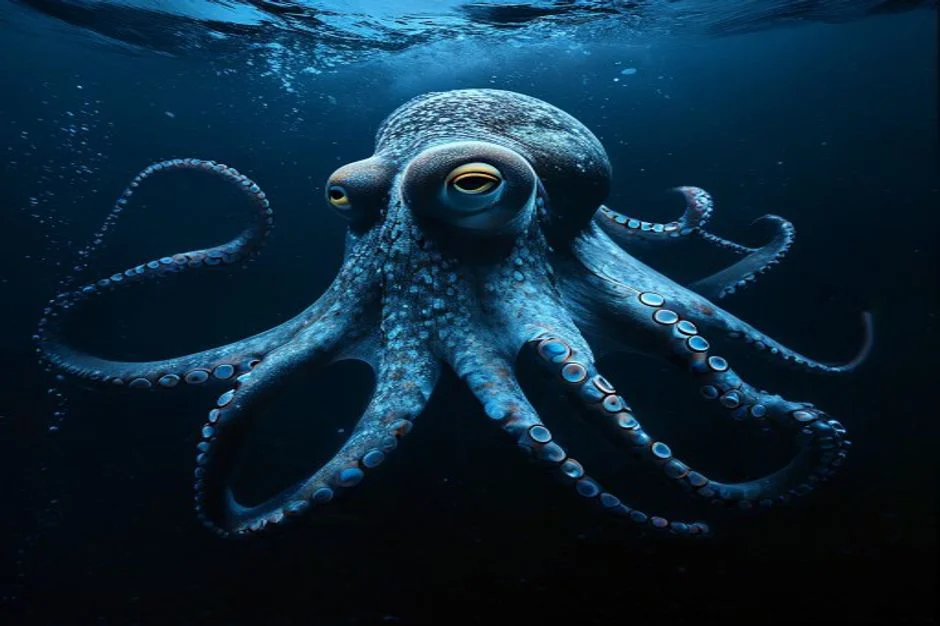
The giant squid (*Architeuthis dux*) ranks among the ocean's most mythologised animals. For centuries sailors described it as the Kraken. Science confirmed the species in the 19th century. Adults reach 13 m and 275 kg. Yet divers never encounter one in the wild: it lives at 500–1,000 m depth, far beyond recreational and technical diving limits.
*Architeuthis dux* is the only truly giant squid species — distinct from the colossal squid *Mesonychoteuthis hamiltoni*. Typical adults measure 8–10 m including tentacles and weigh 100–200 kg. The largest documented females reach 13 m and 275 kg. It holds the record for the largest eyes in the animal kingdom: up to 27 cm in diameter, roughly the size of a football.
The story of its discovery spans centuries of dismissed sailor accounts — the Nordic Kraken, inky sea monsters dragging ships under. In 1857 Danish zoologist Japetus Steenstrup formally described the species from stranded remains. For another 150 years, every specimen known to science was dead: recovered from sperm whale stomachs, washed ashore, or hauled up incidentally in trawl nets.
The first live footage came in 2004, when Japanese biologists Tsunemi Kubodera and Kyoichi Mori deployed an automated camera with bait at 900 m depth near Japan and captured an *Architeuthis* attacking the rig. It was a landmark moment: for the whole of recorded history only dead giant squid had been studied. Several additional sightings have followed, all relying on submersibles or ROVs.
The giant squid inhabits deep water across all oceans, typically between 300 and 1,000 m. Documented hotspots include the waters around Japan and the Sea of Japan, the coasts of New Zealand, the Atlantic margins of España and Portugal, the Caribbean, and the Gulf of Mexico. It feeds mainly on fish and smaller squid. Its primary predator is the sperm whale (*Physeter macrocephalus*), which dives past 1,000 m to hunt them.
Sperm whales carry the evidence of those encounters on their skin: circular scars 10–20 cm across, left by the serrated suckers of *Architeuthis* during the struggle. This indirect testimony remains one of the clearest signs that genuine battles unfold in abyssal darkness — battles almost never witnessed directly by any instrument or human eye.
For divers, an encounter is effectively off the table. Recreational limits sit at 40 m; advanced technical diving reaches perhaps 150 m. Giant squid live far below either ceiling. The only people who have observed live specimens in their natural habitat are researchers aboard deep-sea submersibles or operating ROVs. For the diving community, *Architeuthis* will remain perpetually out of reach.
What is reachable: large squid that are not giant ones. The Humboldt squid (*Dosidicus gigas*) inhabits the eastern Pacific — Sea of Cortez, Chile — and grows to 1.5 m. Experienced divers can encounter it on night dives, though it is aggressive and has attacked divers. The bigfin reef squid (*Sepioteuthis lessoniana*) of the Indo-Pacific is calmer and regularly seen on tropical night dives.
The giant squid is one of the rare ocean animals that remains genuinely mythic for divers — not because its existence is disputed, but because no diver will ever see one in habitat. Knowing it moves 800 m below you during a recreational dive is striking context. Real cephalopod encounters happen with Humboldt squid in the Sea of Cortez or with reef squid on night dives. The legend is biological fact; the sighting remains impossible.