
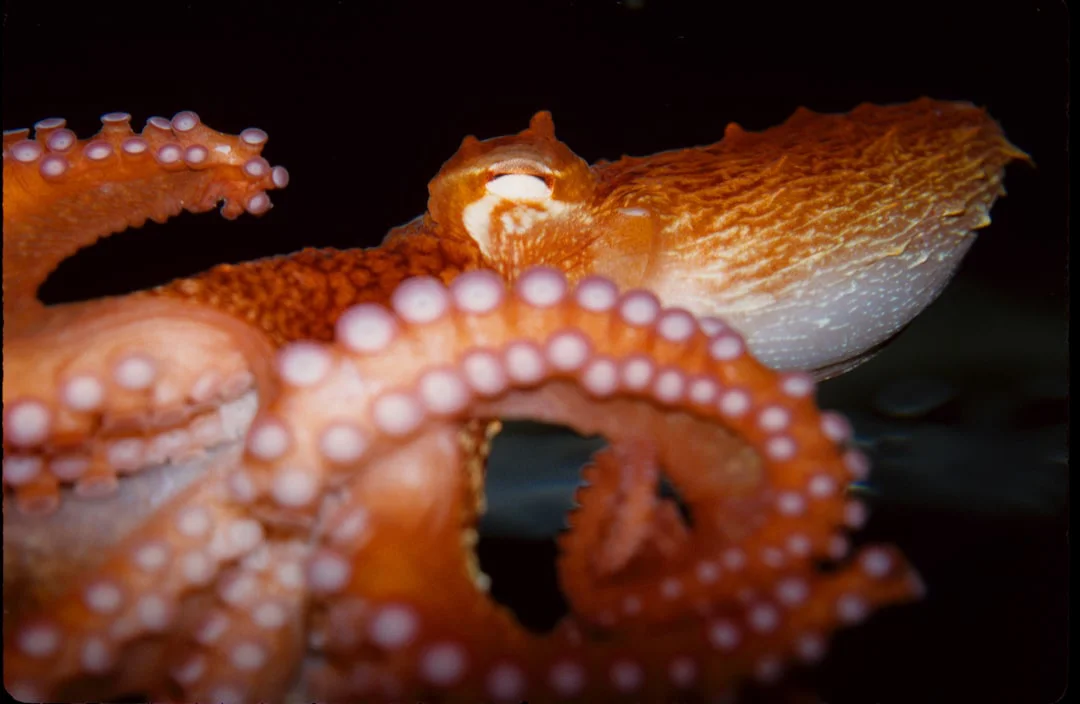
*Enteroctopus dofleini* is the largest octopus on the planet. It inhabits the cold waters of the North Pacific, from Japan to California, with particularly dense populations off British Columbia and Alaska. Adult males can weigh 70 kg with a tentacle span of 4 m. For divers used to the common Mediterranean octopus, a first encounter with a giant is a disorienting shift in scale.
The giant Pacific octopus holds the title of largest octopus species in the world. It ranges across cold North Pacific waters — 5–15 °C — from Japan and Korea through Russia's Sea of Okhotsk, Alaska, British Columbia, Washington, Oregon, and down to California. The densest, best-documented populations cluster in Puget Sound, around Vancouver Island, and in parts of the Sea of Cortez where breeding individuals arrive from further north.
The numbers are hard to argue with: typical adult males run 25–50 kg, with exceptional documented specimens reaching 70 kg and tentacles spanning 4–5 m. Females are smaller but lay 50,000–100,000 eggs in a single clutch, guarding them for 6–10 months without eating before dying. Total lifespan: 3–5 years — brief for an animal of that scale. The sensory system runs to eight brains (one central, one per arm), three hearts, 240 suckers per arm (1,920 in total), and chromatophores covering the skin.
Behaviourally, the giant Pacific octopus diverges from the common Mediterranean octopus in key ways. It tends to be more territorial and less reflexively curious. Individuals hold a den for months, treating it as a fixed home base. Hunting happens around dawn and dusk, targeting crabs, clams, and fish. For divers, locating one means learning its schedule. Local guides at Vancouver Island and in Alaska track specific individuals that occupy the same den for years.
Cognitive capacity: like all octopuses, the giant Pacific displays striking intelligence. Aquarium studies — not something to replicate underwater — show individuals recognising specific keepers, solving layered puzzles, and exhibiting distinct personalities. The difference from the common octopus is physical weight: a 50 kg animal with 4 m tentacles turns any interaction into something you take seriously.
Finding them: dives run over rocky substrate between 12–25 m in cold water. Look for dens littered with broken crab shells and clamshells — the octopus's discard pile marks the entrance. Night and twilight dives raise the odds significantly. In productive sites, experienced divers typically encounter 1–2 individuals per dive. For serious macro and cephalopod photography, semi-nocturnal dives in September–November, when males are most active, stack the chances further.
Best destinations: Vancouver Island, Canada, with sites like Browning Wall and Hunt Rock holding resident populations year-round. The Sea of Cortez offers seasonal encounters around La Paz and Isla del Espíritu Santo. In Japan, Hokkaido and Aomori prefecture have an established drysuit diving tradition focused on the species, though it draws mostly domestic photographers rather than international dive tourism. Alaska hosts the most spectacular sightings but access is tightly seasonal and logistically demanding.
Gear and experience: a drysuit with adequate undergarment is non-negotiable in 8–12 °C water, along with a cold-water regulator and a powerful torch for twilight dives. Divers with fewer than 50 cold-water dives logged find the odds stacked against them — the octopus is cryptic and demands a trained eye. The reliable approach is to dive with a local guide who knows the resident individuals of a given site.
The giant Pacific octopus sits at the top of what cold-water diving offers. Divers who have built experience with cephalopods in warmer seas and want to move up a bracket will find that *Enteroctopus dofleini* in its natural habitat resets the frame of reference entirely. Vancouver Island is the most accessible base with the strongest dive infrastructure. A week in September or October with a seasoned guide yields at least 2–3 solid encounters. For underwater photography, there is no substitute for this species.