
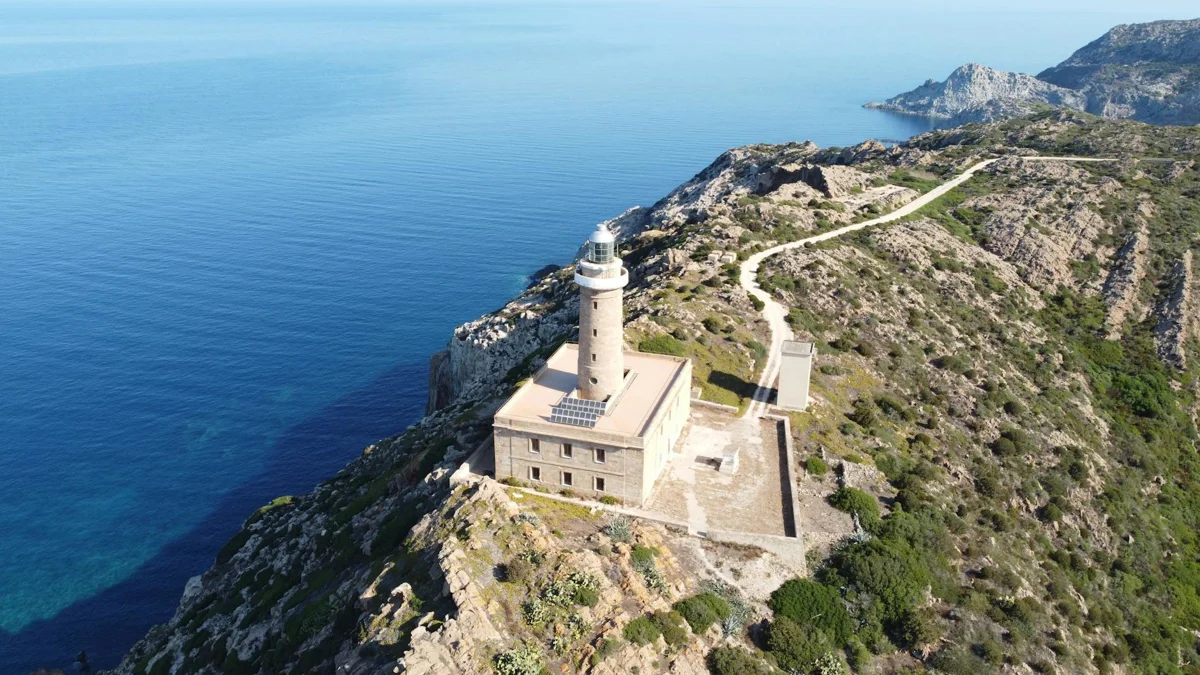
Capo Carbonara, at the southeastern tip of Sardinia, has been a marine protected area since 1998 and is one of the few Mediterranean sites where red coral (*Corallium rubrum*) still grows in dense colonies at recreational depths. Phoenician and Roman wrecks, vertical walls, warm water. A high-quality destination for divers with historical and biological interests who have already explored Capo Caccia to the north.
Capo Carbonara marks the southeasternmost point of Sardinia, facing the island of Villasimius. It was designated a marine protected area in 1998 with three tiers of protection. Zone A, the fully protected core, bars all activity. Zone B permits supervised diving with permits. Zone C allows navigation but prohibits fishing. That strict enforcement has allowed red coral, sea fans, and grouper populations to recover to densities largely absent from the rest of the Italian Mediterranean.
Red coral (*Corallium rubrum*) is the biological centrepiece of Capo Carbonara. Colonies accessible to recreational divers — Advanced certification plus nitrox — sit between 30 and 45 m. Walls carry branching red coral up to 30 cm tall in concentrations that recall the Mediterranean of the 1960s. The ban on coral harvesting in force since 1998 is directly responsible for that recovery. For underwater photography centred on red coral, few Mediterranean sites compare.
Historical wrecks: the area holds several accessible sites. The Romagna, an Italian WWII merchant vessel, rests at 30-35 m. A Phoenician wreck dating to the 7th century B.C. lies in a specially protected zone with tightly regulated access. A Roman wreck with scattered amphorae can be dived with an archaeological guide. The Vaporetto, a 19th-century steam vessel, sits at 25 m. Only dive centres holding a special permit may take divers to the Phoenician wreck; the site is monitored by the Soprintendenza Archeologica.
Other dive sites: Variglioni offers rocky formations with small caverns. Punta Santo Stefano is a drift dive in light currents. Secca dei Berni is a seamount with high biodiversity. Cala Caterina is the easy entry-level option. Depths range from 12 to 45 m; water temperature runs from 14 °C in February to 26 °C in August, with visibility between 25 and 40 m depending on conditions.
Logistics: flights to Cagliari, Sardinia's capital, depart from almost every European city — Ryanair and comparable carriers keep fares low. Car hire gets you to Villasimius in 40 minutes. Accommodation ranges from guesthouses around 50 € to hotels at 100–250 €. Dive operators: Capo Carbonara Diving, Marlin Diving, and Villasimius Diving. Guided dives cost 45–65 €; a six-dive kit runs 240 €. Italian is the working language; English is understood in all dive centres, German frequently as well.
The pleasant surprise is the food. Southern Sardinia carries a robust traditional culinary culture: malloreddus alla campidanese, roast suckling pig (porceddu), grey mullet bottarga, and the Cannonau and Vermentino wines of the island. The inland villages of Castiadas and Burcei remain genuinely unspoilt. For couples or families where only one person dives, the destination pairs quality diving with authentic gastronomic and cultural travel.
The limitation is the operational season. May to October is the realistic window; dive centres operate sporadically in winter. The deeper wrecks demand specific training — Advanced plus Nitrox plus prior wreck experience. For Open Water divers without further credentials, the offering is worthwhile but confined to shallower sites.
Capo Carbonara is a high-quality Mediterranean destination for divers drawn to red coral, wrecks, and protected biodiversity. It pairs naturally with Capo Caccia in northern Sardinia (see note 023) for a full week of Sardinian diving. For divers already familiar with other Italian sites such as Sicily or the Aeolian Islands, Sardinia offers a less commercialised, wilder alternative. In September, with settled weather, the diving quality alone justifies the trip.