
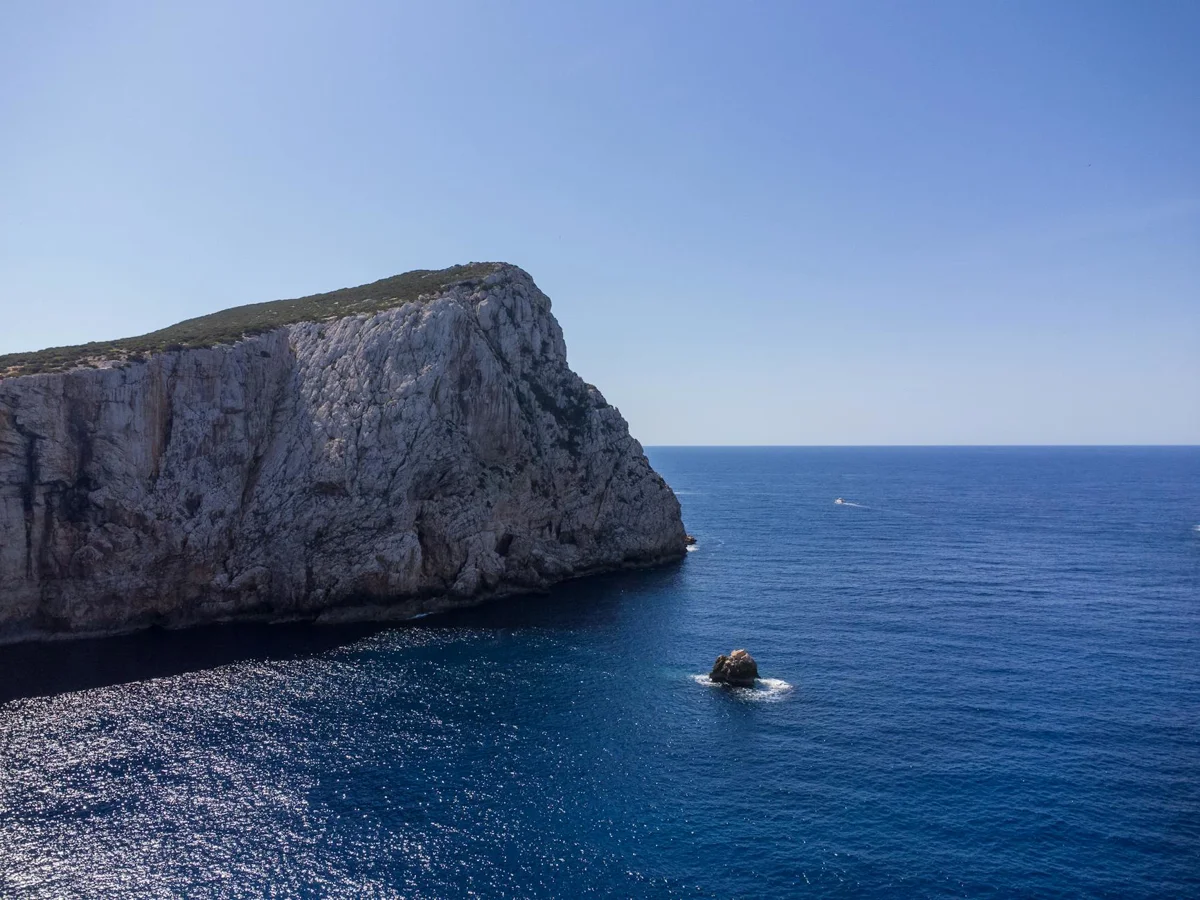
Capo Caccia is a 200 m limestone cliff on the northwest tip of Sardinia that keeps dropping underwater past 100 m. The wall is riddled with caves — some connected to land grottos, others fully submerged. Among Mediterranean destinations, few organise recreational cave diving as well as this corner of the island.
Capo Caccia towers over Alghero on Sardinia's northwest shore. Above the waterline: sheer limestone cliffs 200 m tall, medieval lookout towers, and the Grotta di Nettuno accessible by a staircase cut into the rock. Below it: the same wall keeps dropping, broken up by sea caves, tunnels, arches and grottos with air chambers inside. Nowhere else in the Mediterranean packs this much karst geology into a single headland.
Five sites dominate the dive map here. Grotta di Nereo has two entrances — one at 25 m, one at 32 m — with 200 m of penetrable passage, widely regarded as the largest submarine cave in the Mediterranean. Grotta dei Cervi has air chambers draped in stalactites. Grotta della Madonnina is a compact cave with a quieter atmosphere. Capo Galera is a red coral wall. Punta Cristallo offers a gentle drift with abundant fish life. Depths range from 18 to 40 m depending on the route.
The biological headline is red coral (*Corallium rubrum*). Colonies at 35–50 m have survived centuries of commercial harvesting because the site's depth and limited access kept them out of reach. With a deep diver certification and nitrox, you reach walls of living red coral at 40 m, almost no current, visibility pushing 25–30 m. For underwater photography, this is the closest the Mediterranean gets to a tropical macro destination.
Associated fauna: spiny and slipper lobster in numbers that catch first-time visitors off guard, large conger eels deep in the caves, moray eels, mature grouper, and seasonal shoals of sand smelt and picarel. The protected park zone prohibits spearfishing, and the effect on density is unmistakable. Diving here feels like Mediterranean waters from decades ago, before commercial pressure stripped similar sites bare.
Getting here: fly into Alghero-Fertilia — Ryanair links it to several European cities cheaply — hire a car and stay in Alghero or one of the smaller villages nearby. The main dive centres are in Alghero harbour or at Porto Conte, closer to Capo Caccia. Guided dives run 40–55 €; a six-dive package costs around 220 €. Staff usually speak Italian and English, often German or French at the busier centres. Alghero still uses a Catalan dialect, a legacy of medieval Aragonese settlement — an unexpected detail in the middle of Sardinia.
Water temperature: 14 °C in March, up to 25 °C in August. May–June and September–October are the prime months. July and August bring packed boats and prices roughly 25 % higher. October is particularly good — 5 mm wetsuit still comfortable, visibility frequently hitting 40 m. Winter diving is possible between wind windows but centres operate on reduced schedules.
The drawback is predictable: peak August crowds. On busy days Grotta di Nereo can have 30–40 divers inside simultaneously. Disturbed silt cuts visibility and the experience turns claustrophobic. The fix is simple — ask the centre for a 07:30 or 15:30 shotline entry time rather than the standard 10:00–12:00 slot. Professional operators understand the problem and can plan around it.
Capo Caccia is among the Mediterranean's top destinations for anyone drawn to cave diving, wall diving and underwater geology. Pair it with Alghero — Sardinian food, local wine, beaches — and it works as a trip even for non-divers travelling in the same group. Against Malta and Croatia for a September slot, what tips the balance here is the combination of caves, red coral and lobster found together in one place.