
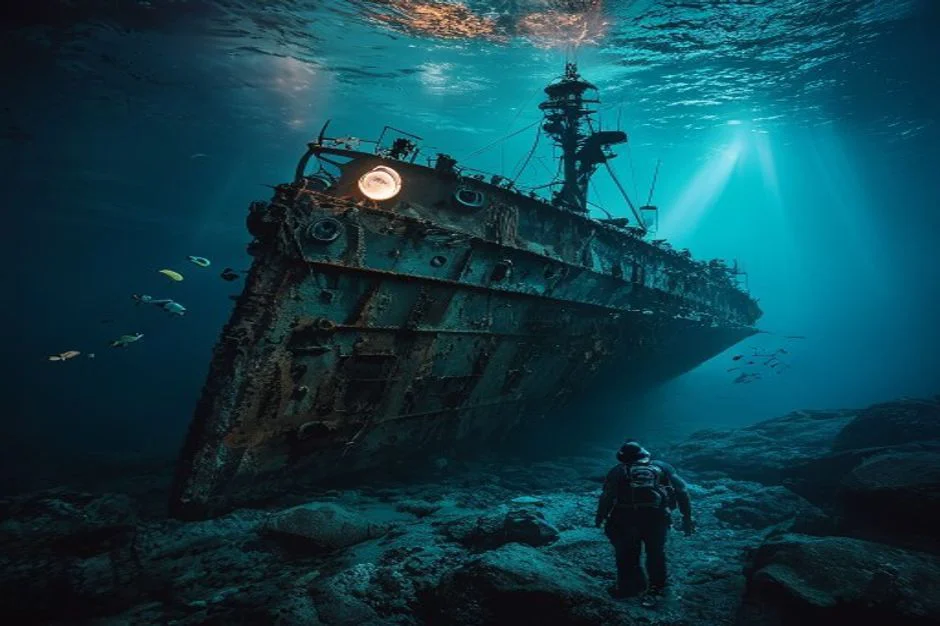
Scapa Flow is the sheltered bay in Orkney, Scotland, where on 21 June 1919 the Imperial German Fleet was deliberately scuttled to prevent capture by the Allies. 74 ships went to the bottom; several are still diveable today. It is arguably the most visited historic underwater graveyard in the world, and for wreck divers it is a site of pilgrimage.
The historical context matters. In 1918, after the Armistice, the German fleet was interned at Scapa Flow while the Allied powers debated its fate. Admiral Ludwig von Reuter, cut off from reliable communication with Berlin, chose to sink the fleet rather than let it fall into British hands. On 21 June 1919, in a coordinated operation, 74 ships opened their sea-cocks and went down. Nine German sailors died — the last casualties of the war. Most vessels were subsequently salvaged for scrap during the 1920s and 1930s. What remains is what divers visit today.
Seven wrecks are the main draws: three battleships — SMS König, SMS Kronprinz Wilhelm, SMS Markgraf — and four light cruisers — SMS Cöln, SMS Brummer, SMS Dresden II, SMS Karlsruhe. Depths range from 25 to 45 m. All lie upside down, having rolled as they sank, so you wreck dive beneath the decks rather than above them. The sensation is claustrophobic at first: 30,000 tonnes of German steel that has been submerged for over a century presses down from above.
These are advanced dives. Wrecks sit between 25 and 45 m, visibility runs 5–10 m on a typical day (occasionally 15 m under ideal conditions), tidal currents can be significant, and water temperature ranges from 6 to 12 °C depending on the month. A well-insulated drysuit is non-negotiable. A wreck specialty or solid prior experience on deep wrecks is strongly recommended. Penetration dives should only be attempted with a dedicated wreck course and a local guide.
Getting there takes planning. Fly to Inverness or Aberdeen, then take a connecting flight or ferry to Kirkwall, Orkney's main town. Dive operators are based in Stromness and Houton, running liveaboard vessels carrying 8–10 divers for five to seven days. The liveaboard format suits Scapa Flow well: morning departures at 09:00, two dives, back by 17:00, sleep aboard or at a nearby guesthouse.
Costs: a six-day liveaboard with 12 dives, meals, and a guide runs 1,200–1,600 €. It is a premium destination, though not at the level of Truk Lagoon or Bikini Atoll. Flights to Kirkwall are expensive — Loganair holds a near-monopoly — expect 200–400 € from Aberdeen. Car hire in Orkney is around 60 €/day. Total for the week: roughly 1,800–2,500 € per person from continental Europe.
What catches first-timers off guard is the silence. Wreck diving on German ships at 35 m in dark water, torch in hand, no sound except your own breathing and the faint creak of corroded steel shifting in the current. You find engine telegraphs, compasses, officers' mess crockery in cabins sealed for a century. This is a historical dive rather than a marine-life dive. The fauna is incidental; history is the main event.
The disappointment is the Scottish weather. Rain, wind, swell. Cancellations are common even in July and August, the best months. Liveaboards try to shelter in calmer spots when a gale comes through, but losing one or two dive days per week is realistic. The operating season runs from May to September; outside those months most operators close down.
Scapa Flow is a pilgrimage site for wreck divers with a serious interest in twentieth-century history. It is not the right choice for a first deep wreck — better to build experience in the Mediterranean or Red Sea first — but once a diver has a few solid wrecks behind them, Scapa Flow is the logical next step. The combination of depth, cold, historical density, and atmosphere makes it unlike anywhere else in Europe. Miss it once too often and it starts to feel like an omission.