
The Seychelles most travellers know — Mahé, Praslin, La Digue — are beach resorts with decent diving. The Outer Islands are a different proposition entirely: remote atolls 1,000 km south of Mahé, reachable only by liveaboard, carrying biodiversity on par with the Galápagos. This is expedition diving for those who have already worked through most of the bucket list.
The Seychelles archipelago comprises 115 islands spread across 1.4 million km² of the Indian Ocean. The inner granitic islands — Mahé, Praslin, La Digue — are polished tourist destinations with diving that ranges from decent to heavily impacted. The Outer Islands are a different world: coralline atolls in near-pristine condition, among them Aldabra, Astove, Cosmoledo, Assumption, Alphonse, Farquhar, and Desroches. Aldabra has held UNESCO World Heritage status since 1982 and is regarded as one of the best-preserved marine areas on the planet.
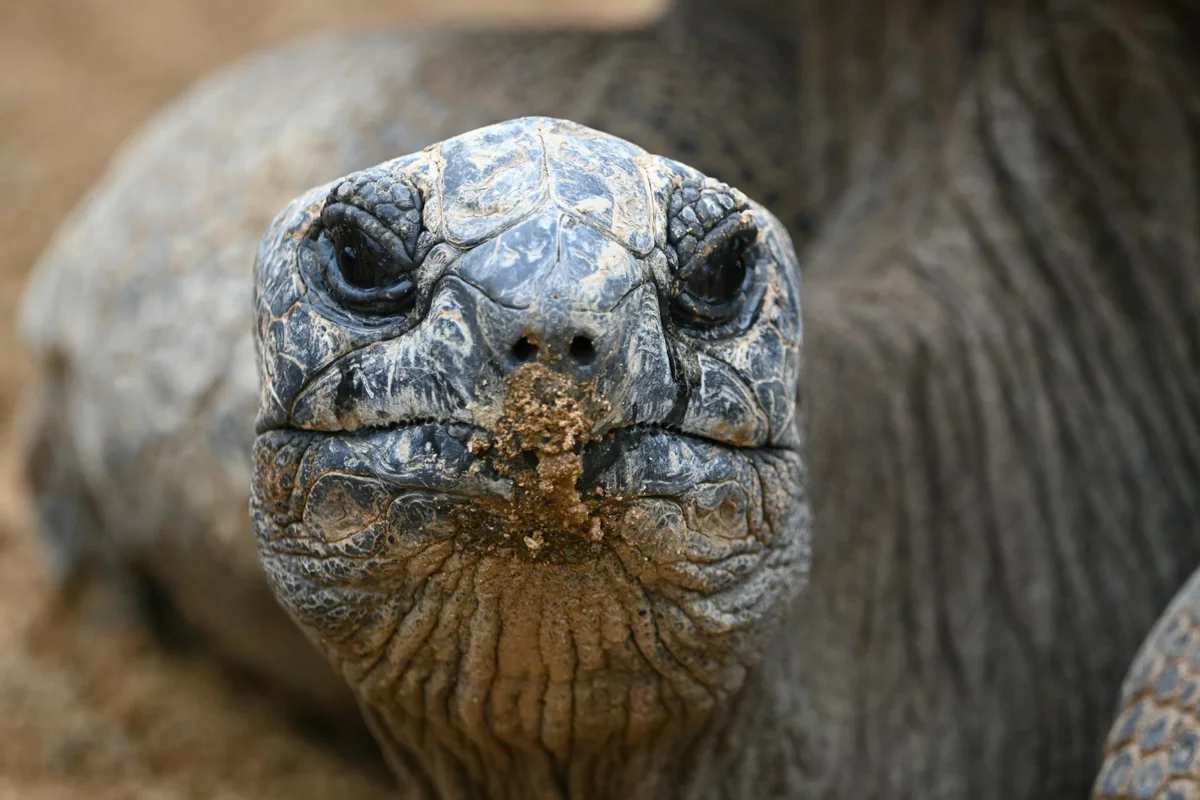
Aldabra is an atoll 34 km long whose four landmasses encircle a central lagoon of 155 km². On land, the atoll is world-famous for the Aldabra giant tortoise (*Aldabrachelys gigantea*) — over 100,000 individuals, the largest population of any giant tortoise species anywhere. Underwater, the picture is equally striking: green and hawksbill turtles in numbers that have vanished elsewhere, reef sharks, resident reef mantas, goliath grouper topping 100 kg, and roving pelagic schools that materialise and dissolve in the blue.
Access is exclusively by liveaboard. Expeditions depart from Mahé, take 4–5 days to reach the atoll, allow 7–10 days of diving, and require another 4–5 days to return — 14–16 days total. Established operators running the route include Indian Ocean Explorer, Galatea II, and Maya Dugong. Per-person cost sits between €4,500 and €7,000, covering everything except flights. With only 6–8 expeditions departing each year between May and November, berths sell out fast.
Diving at Aldabra means vertical walls dropping from 5 m to beyond 200 m, drift dives through the passes — channels connecting the lagoon to open ocean — and coral gardens that show no visible degradation. Shark sightings are a certainty on every dive: grey reef, whitetip, hammerhead, and tiger in season. Reef mantas work the cleaning stations on a daily rotation. The giant groupers have no reason to fear a diver and will hold their ground at arm's length.
Astove lies to the north of Aldabra and is similarly accessible only by liveaboard. Its signature feature is the Astove Wall, a vertical drop from 3 m straight down to 300 m — consistently rated among the finest walls in the world. Drift dives run at 2–3 knots through water thick with pelagic life, and on most days there will not be another diver in the water. For anyone trying to picture what the Pacific felt like half a century ago, Astove is about as close as the modern world gets.
Cosmoledo completes the logical circuit: an even less-visited atoll with shark populations in overwhelming numbers, mantas, and trophy-sized fish throughout. Most liveaboards combine Aldabra, Astove, and Cosmoledo in a single itinerary, which gives the fullest possible read on the outer Indian Ocean. Fewer than 200–300 divers reach these atolls in any given year — a figure that seems almost absurd given what is on offer.
Logistics: flights to Mahé connect via Istanbul, Paris, Dubai, or Doha; there are no cheap direct European options. Visas are issued on arrival. Pre- and post-trip accommodation in Mahé runs €100–300 per night for a double room. Kit requirements are minimal — a 3 mm wetsuit or a lycra skin, given water temperatures of 26–29 °C year-round. Operators hold their passengers to a strict experience floor: Advanced Open Water certification and a minimum of 100 logged dives.
The Outer Islands of Seychelles represent the upper tier of Indian Ocean diving — high cost, complex logistics, severely limited availability. The quality of what is underwater, however, is genuinely comparable to the Galápagos or Cocos Island: fauna that has not learned to retreat, coral structure with no visible human fingerprint. For underwater photographers working at a professional level, these atolls sit on the mandatory list. For anyone else, a single expedition to Aldabra-Astove-Cosmoledo is the kind of trip that recalibrates what diving can be.