
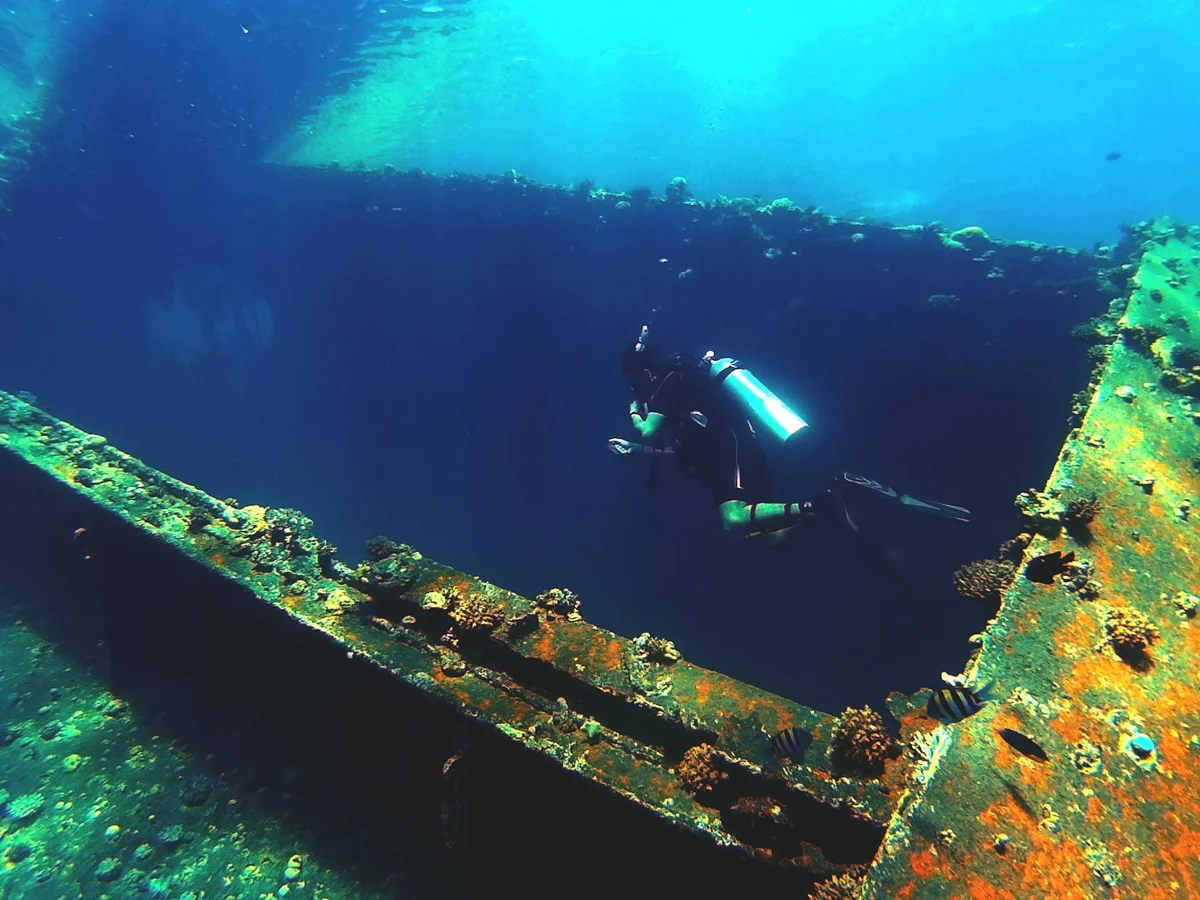
Sudan is the Red Sea's worst-kept secret. Same waters as Egypt, far better-preserved marine life, almost no divers, and Cousteau's Conshelf II ruins still sitting in situ at 12 m on Sha'ab Rumi. Logistics are demanding and the political situation is complicated, but anyone who dives here leaves with a clear sense of what the Egyptian Red Sea used to be.
The Sudanese Red Sea runs along the coast between the Egyptian border and Eritrea, but diving is centred on the Port Sudan area. The main reefs are Sha'ab Rumi, Sanganeb, Sha'ab Suedi, Mesharifa, and the rarely visited Angarosh and Abington. Access is almost exclusively by liveaboard — seven to ten days out of Port Sudan, with weekly departures from March through October. Without a liveaboard there is effectively no diving; shore diving does not exist here.
Sha'ab Rumi is the historical dive. In 1963, Cousteau and his team installed Conshelf II here — an experimental underwater station where eight aquanauts lived at 10 m depth for a week. The structures remain: a hangar built for a mini-submarine, habitable modules, a shark cage, all rusting and colonised by coral. The dive mixes underwater archaeology with sheer living walls and hammerhead stations on the outer plateau.
Sanganeb is an isolated atoll and UNESCO World Heritage site. An Ottoman lighthouse built in 1906 stands on its crest; underwater, a 700 m wall drops from just 5 m depth. The classic dive is the south plateau, where grey reef sharks cruise regularly, thresher sharks appear in August and September, schools of scalloped hammerheads (*Sphyrna lewini*) can reach 100 individuals, and oceanic mantas pass through. Pelagic life here is visibly richer than anything in the Egyptian Red Sea.
What sets Sudanese diving apart is the absence of tourist pressure. Egypt draws 100,000 divers a year; Sudan receives 2,000–3,000. That translates into coral cover you no longer find at Hurghada or Marsa Alam, wildlife that has no reason to flee a diver, and the sensation of working a site that few people have ever touched. Comparing Sha'ab Rumi with Elphinstone feels like comparing two different decades of the same sea.
Logistics: flights to Port Sudan via Estambul, El Cairo, or Dubái — no direct European connections. A visa is mandatory and is handled by the liveaboard operator (50–100 USD). Since 2023 the political situation has been volatile due to internal armed conflict; always verify visa status and travel advisories before booking. Liveaboards run 1,500–2,200 € for seven days, full-board and dives included. Established operators: Tornado Marine, Jolly Roger, Royal Evolution.
Kit and conditions are close to Egypt. Visibility 25–40 m; water temperature 24 °C in February rising to 30 °C in August. A 3 mm wetsuit or a lycra skin is enough for most of the season. Currents can be strong on the outer reefs — Sanganeb and Angarosh in particular — and drift dives are the norm rather than the exception. Depths range from 5 to 40 m depending on the itinerary. Advanced certification and nitrox are recommended.
The disappointment is political instability. Sudan went through a revolution in 2019 and a civil war in 2023. Some operators have suspended entire seasons. Confirm with whichever operator you choose that the trip is genuinely running in the month you plan to travel. The situation shifts fast. When the country is open, the diving is exceptional; when it is not, cancellations have to be accepted.
Sudan is a destination for experienced divers who have already done Egypt and want to see the Red Sea as it looked before mass tourism arrived. Expensive, remote, difficult to organise — but singular. Sha'ab Rumi and Sanganeb offer dives that simply no longer exist on the Egyptian side. For a week of offshore diving you will still talk about years from now, Sudan beats the Egyptian Red Sea. For a comfortable holiday, Egypt is the sensible choice.