
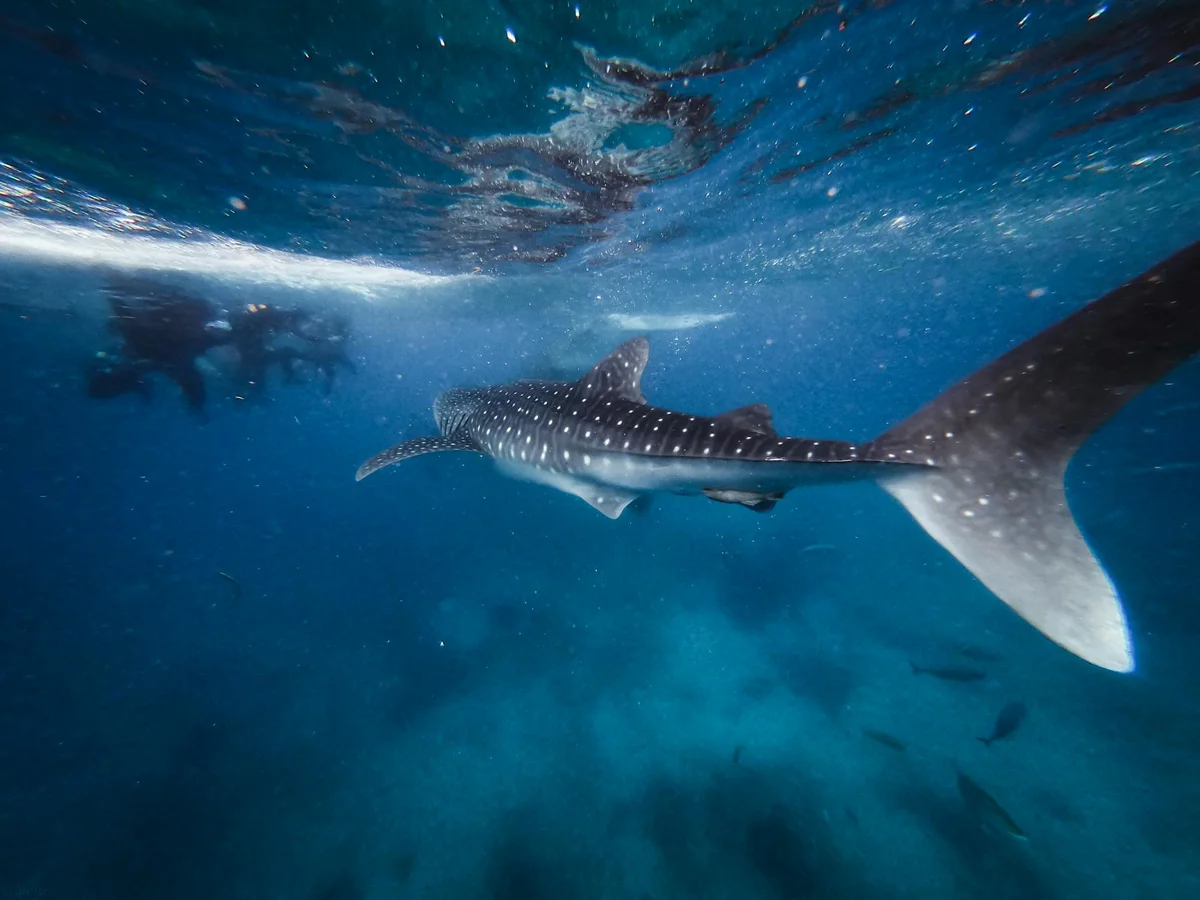
Mafia Island is one of the few places on earth where whale sharks are stable, predictable residents. From October to March, dozens of juveniles gather to feed on plankton in shallow coastal waters just 5–10 m deep. It is the most reliable whale shark destination in the eastern Indian Ocean, and a more authentic alternative to the Maldives or the Philippines.
Mafia is an African island south of Zanzibar and east of Dar es Salaam, Tanzania's economic capital. The contrast with Zanzibar — busy, tourist-heavy — is stark: Mafia has 50,000 inhabitants, basic infrastructure, no large resorts, and a marine park protecting the western coast. The local economy runs on artisanal fishing and a modest but steady dive-tourism circuit that dates back to the 1990s.
Whale sharks (*Rhincodon typus*) are resident at Mafia between October and March. The biology behind the phenomenon: seasonal upwelling enriches coastal waters with plankton, drawing juveniles measuring 4–7 m to feed at the surface. Numbers are remarkable — a half-day trip typically yields 5 to 15 individually identified animals. Encounters are consistently close and prolonged.
All outings are snorkel-only; Tanzania prohibits scuba diving with whale sharks. Surface encounter quality is among the finest anywhere: the sharks cruise at 0–3 m, feeding slowly, unbothered by snorkelers who maintain distance (minimum 3 m, no touching). Trips run 3–4 hours by zodiac, with actual whale shark time typically 30–90 minutes per outing.
Scuba diving in Mafia carries its own weight. The marine park holds healthy reefs, abundant reef fauna and visibility ranging 15–30 m depending on conditions. The headline sites: Kinasi Pass (drift dive with grey reef sharks), Coral Garden (hard and soft coral garden teeming with reef fish), and Manta Reef, a manta cleaning station active August–September. Depths range 12–25 m; water temperature sits at 26–30 °C year-round.
Logistics: fly into Dar es Salaam from Europe via a hub (Dubai, Doha), then a 50-minute internal flight to Mafia or a 4-hour ferry crossing that most divers skip. Lodges start around €100 per night for a double; a handful of private island lodges with diving included reach €250–400 per night. Dive prices run €60–80 per guided dive, with 4-dive packages at €250–300. Whale shark trips cost €90–130 for a half day.
What genuinely surprises visitors is the cultural depth. Mafia preserves swahili tradition without Zanzibar's tourist veneer. Fishing villages, fresh fish markets, and dhows still head out to sea exactly as they have for centuries. The island feels like an actual place rather than a package destination — a meaningful quality for travellers who combine cultural interest with diving.
The disappointments are real too. The whale shark season is short: from April through September encounters are essentially absent, making the calendar non-negotiable. Cost is the other friction point — Mafia's logistical remoteness keeps prices high. A week including flights, lodge and diving from Europe lands easily at €2,000–2,800 per person. The cultural dimension offsets that for some travellers, not for all.
Mafia is a destination for divers who want near-guaranteed whale shark encounters in a genuinely African setting, well outside mass tourism. October to March is the window. The island pairs naturally with a Tanzania land safari (Serengeti, Ngorongoro) for a full two-week trip. For underwater photography and intense megafauna encounters, Mafia ranks in the global top five for whale sharks.