
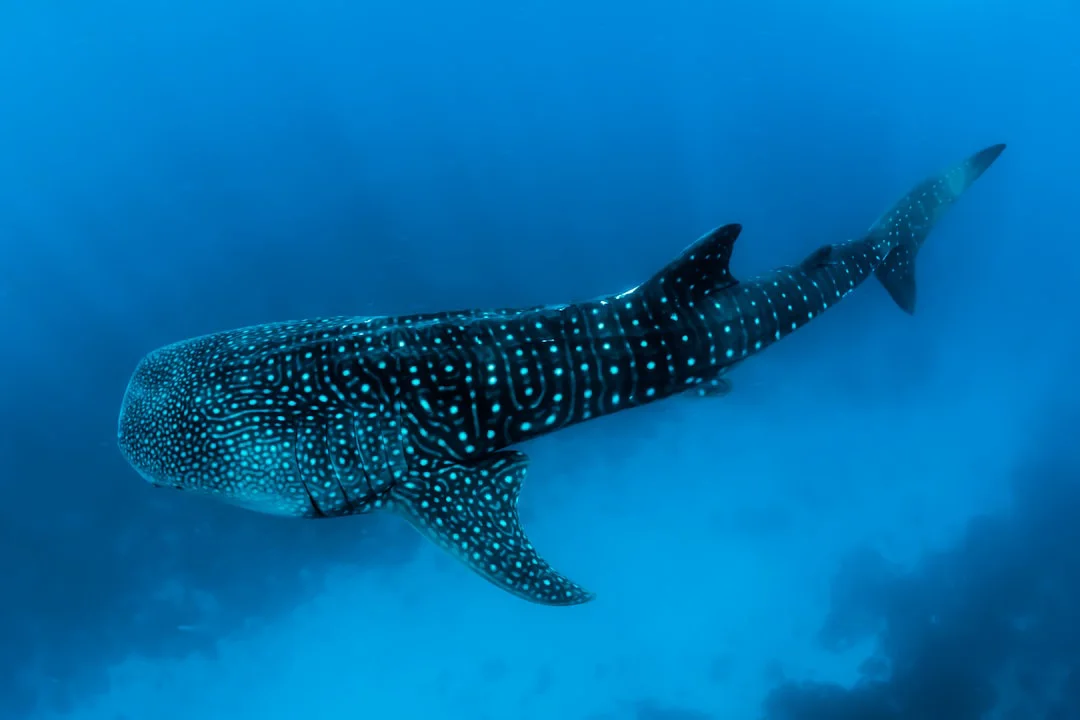
The whale shark (*Rhincodon typus*) is the largest fish on Earth. Divers who encounter one rarely stop to wonder about its sex, yet the distinction matters for understanding behaviour and choosing when to visit. Most sightings at tourist sites involve juveniles and young males; adult females are genuinely rare in accessible waters and head to the deep to give birth.
The whale shark is the largest fish on Earth and the second-largest vertebrate after the blue whale. Adults typically reach 8–12 m; the largest confirmed individuals approach 18–20 m and weigh 15–21 tonnes. Despite that bulk, they are filter feeders: plankton, krill, fish larvae and eggs are the diet. They range through tropical and subtropical oceans worldwide, with resident populations at Mafia (Tanzania), Tofo (Mozambique), Ningaloo (Australia), the Maldives, the Philippines, Yucatán (Mexico) and several other sites.
Telling males from females comes down to one anatomical detail: the area between the pelvic fins on the underside. Males have claspers—two cylindrical extensions that project between the pelvic fins. These are the external reproductive organs. On a fully grown whale shark, claspers stand out clearly from a few metres away: pale, elongated structures against darker skin. Females lack them entirely; the ventral surface between the pelvic fins is smooth.
Juveniles complicate things. Young animals have rudimentary claspers or none at all, making sex determination difficult in the field. The overwhelming majority of encounters at sites such as Ningaloo, the Maldives, Tofo and Mafia involve animals between 4 and 8 m, and most are male. Adult females, which can exceed 10–15 m, are scarce at accessible diving spots because they migrate to deep water to pup.
Whale shark reproduction is ovoviviparous: eggs hatch internally and the mother gives birth to live young. A single female can carry more than 300 embryos simultaneously. Pups are born at roughly 50–60 cm. Actual births have almost never been documented in the wild, and knowledge of pupping grounds remains fragmentary. Deep-water zones near the Galápagos, the Philippines (St. Helena Mount) and the Banco de Bermuda are suspected nursery areas.
Individual identification relies on the unique pattern of white spots against dark skin—effectively a fingerprint. Citizen-science databases such as Wildbook for Whale Sharks allow divers to upload photos of the left flank, taken behind the gills, and receive confirmation of whether that individual is already registered or new to the catalogue. Over time, repeated identifications map migration routes and track individual histories across years.
Seasonality varies by destination. Mafia: October–March. Tofo: June–November. Ningaloo: March–July. Maldives (Hanifaru): June–November. Philippines (Donsol, Cebu): February–June. Yucatán (Holbox): June–September. Planning around peak windows dramatically improves encounter rates. Some populations are effectively resident—Mafia and Holbox, for instance—while others, like Ningaloo and Tofo, follow clear migratory patterns.
Whale sharks are harmless to humans, but their sheer size creates collision risk. The standard protocol is a minimum 3 m distance at all times, no touching, never positioning in front of the animal, and no strobes near juveniles. Tanzania, Australia, Mexico and the Philippines restrict encounters to snorkel only—no SCUBA—based on research showing that tanks and exhaust bubbles alter behaviour. The Maldives and certain other destinations still permit SCUBA.
Distinguishing male from female whale sharks is not complicated once you know what to look for, but it requires a calm, patient approach and a decent view of the underside. Most encounters at established sites will be young males. The chance of meeting a large adult female in accessible water is genuinely uncommon. Uploading your photos to Wildbook for Whale Sharks is one of the most direct contributions a recreational diver can make to the long-term study of this species.