
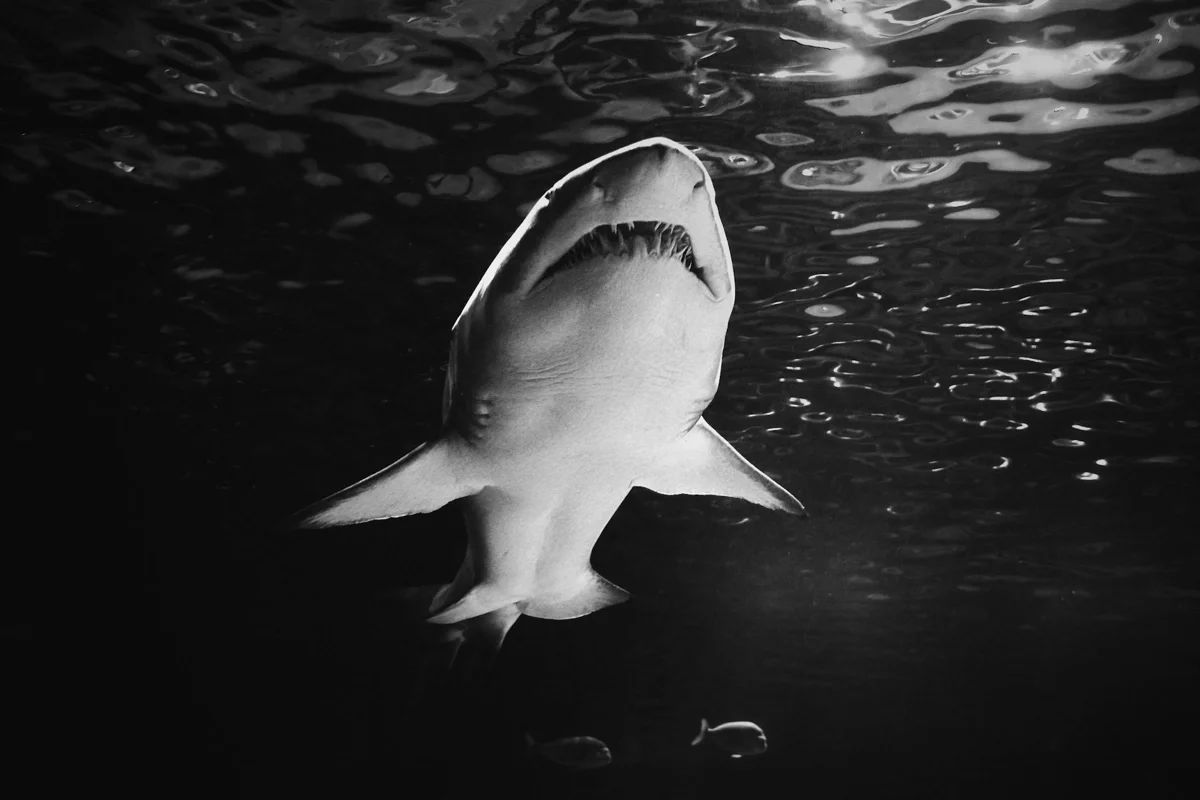
The great white shark (*Carcharodon carcharias*) carries a reputation as the ocean's deadliest animal. The numbers don't support that: fewer than 5 fatal attacks occur globally each year. Whether cage-free diving with great whites is viable is a legitimate question. The short answer is yes — at specific sites with specific operators — but the context matters before committing.
The great white shark is the ocean's largest macropredatory apex predator. Adults measure 4–6 m and weigh 700–2,000 kg; the largest documented individuals reach 7 m and 3,000 kg. The species ranges across temperate and cold waters worldwide: South Africa, California, Australia, Mexico (Guadalupe), New Zealand, Chile, and even the Mediterranean (residual populations). Biology indicates lifespans exceeding 70 years and late sexual maturity — 15–25 years — making the species acutely vulnerable to overfishing.
The danger myth: ISAF data records 5–10 fatal shark attacks globally per year across all species, not great whites alone. Of those, great whites account for roughly 1–3 annually. Set against road fatalities (1.5 million per year) or drownings (236,000 per year), the statistical probability of dying by great white is vanishingly small. Jaws (1975) has warped public perception for five decades.
Cage diving with great whites has been the traditional format. Key sites: Guadalupe (Mexico, before the Mexican government closed the island in 2022), the Farallones off California, Neptune Islands in Australia, Gansbaai and Mossel Bay in South Africa. At all of these, the standard method is a floating cage with chumming to draw sharks close. Divers shoot from inside; meaningful risk is negligible.
Cage-free encounters exist at only a handful of locations. The best-known is Stewart Island and Bluff in New Zealand, where experienced freedivers — not SCUBA — meet juvenile great whites at or near the surface without any cage. Cabo San Lucas in Mexico offers cage-free trips primarily with blue sharks and mako, with occasional great whites, though their presence is incidental. On South Africa's west coast near Cape Point, a small number of experienced operators document cage-free encounters with freedivers under tight protocols.
The ethics: chumming is standard across all great white operations. Critics argue it conditions sharks to associate humans with food, altering natural behaviour and raising risk for coastal swimmers. Proponents counter that shark diving generates the only meaningful economic incentive to protect *Carcharodon carcharias*, listed as Vulnerable on the IUCN Red List. Whether to participate is a personal call.
The Guadalupe closure (2022): the Mexican government shut the island to tourism operations in 2022, removing what had been the world's most reliable great white destination. The official reason was behavioural disturbance from chumming. The decision is contested — it cut local economic income while aiming to protect the animals. The practical result is that divers targeting great whites now route to South Africa or Australia.
Gear and experience: cage-free diving requires at minimum advanced open-water experience, ideally competitive freediving certification, and a specific mental composure. Great whites are curious animals that may deliver a test bite when investigating something unfamiliar. The margin between a calm encounter and an incident can come down to body movement and position. This is not a destination for beginners or for anyone uncomfortable around large sharks.
The bottom line: cage-free great white diving is possible, rare, contested, and demanding. For most divers, the cage remains the sensible choice — same view, negligible risk, workable photography. For seasoned freedivers pursuing the closest possible encounter with an apex predator, cage-free trips in New Zealand or South Africa with the right operators represent a genuine option. Serious preparation is required; this is not a casual itinerary add-on.