
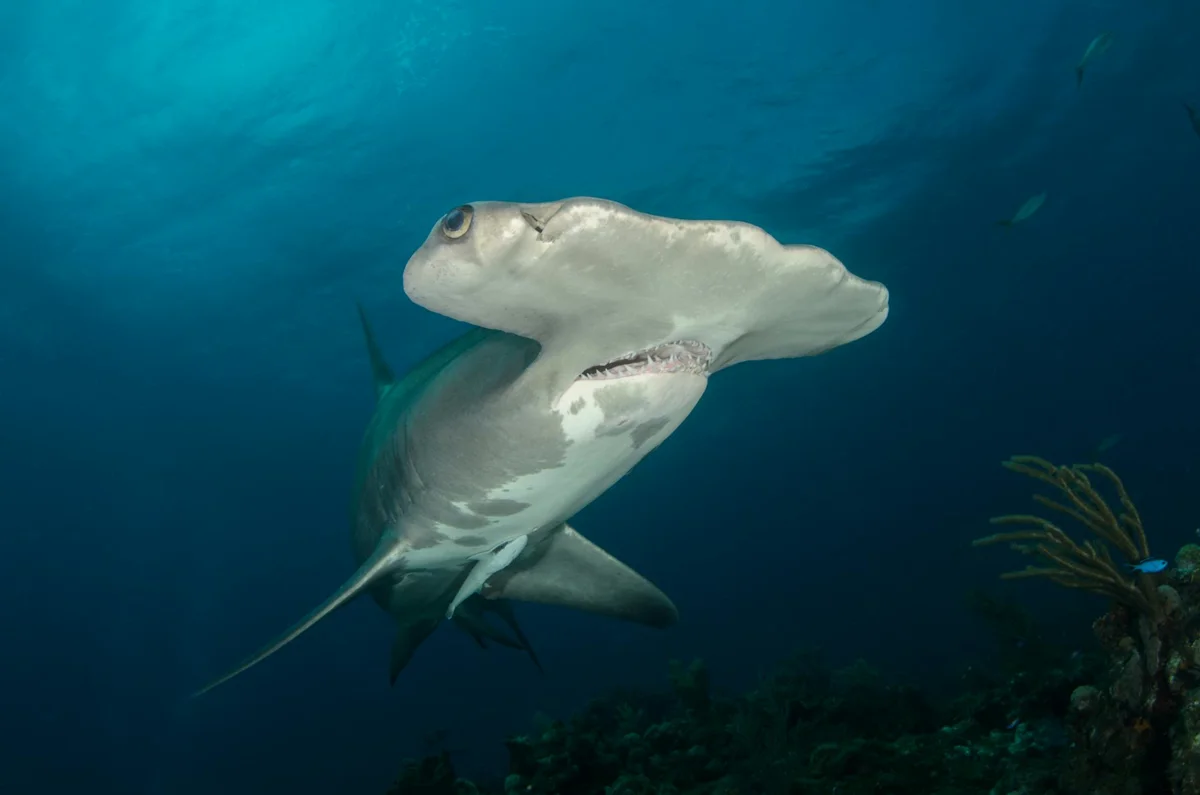
The scalloped hammerhead (*Sphyrna lewini*) is one of the few sharks that gathers in schools. The massive aggregations at Galápagos, Cocos, and Malpelo represent behavioral phenomena that science still cannot fully explain. Hypotheses range from reproduction to magnetic navigation. For divers, these schools rank among the most compelling spectacles in the eastern Pacific.
There are 9 species in the family Sphyrnidae. Recreational divers encounter mainly *Sphyrna lewini*, the scalloped hammerhead — the most abundant and the one that schools. Adults typically reach 3–3.5 m and 80–150 kg. The species ranges across tropical and temperate waters globally, yet large aggregations occur at only four or five places on Earth: Galápagos, Cocos, Malpelo (Colombia), Roca Partida (Socorro, México), and Layang Layang (Malaysia).
At Wolf and Darwin (Galápagos) and Bajo Alcyone (Cocos), schools of 100–500 individuals are routine. At Malpelo, aggregations exceeding 1,000 animals have been documented. Those numbers are unique in the animal kingdom: no other shark concentrates in such quantities so consistently and in such geographically predictable locations. Understanding why remains one of the open questions of marine biology.
Current scientific hypotheses: 1) Reproduction — schools are dominated by adult females, suggesting males visit these sites to mate. 2) Magnetic navigation — hammerheads carry magnetoreceptors in their distinctive heads, and the seamounts where they aggregate contain magnetic anomalies. 3) Thermoregulation — schools form in warmer surface water during the day and disperse into cold, deep water to hunt at night. 4) Social cleaning — wrasse cleaning stations are abundant at these sites and may drive daytime residency.
Satellite telemetry studies show that scalloped hammerheads cover enormous distances. Individuals tagged at Galápagos have turned up at Cocos (700 km to the north), in coastal waters off Costa Rica, and as far as El Salvador. The genetic connectivity between Galápagos and Cocos populations points to active reproductive exchange. For conservation, that means protecting a single site is insufficient — migratory corridors between marine parks are essential.
Schooling behavior is social, not predatory. Hammerheads in a school do not hunt. After dark they scatter into deep water to feed on squid, pelagic fish, and rays, then return to the seamounts each morning to regroup. The optimal window is roughly 08:00–13:00 local time, before midday heat drives them deeper. Divers holding position with a reef hook at 18–25 m during those hours have the best chance of a prolonged encounter.
Conservation status: the scalloped hammerhead has been listed as Critically Endangered by the IUCN since 2007. Shark finning is the primary driver — fins fetch up to 100 USD/kg in Asian markets. Global populations have declined 80–90 % over the past fifty years. Galápagos, Cocos, and Malpelo function as protected refuges, but outside those parks the species faces intense pressure from targeted and bycatch fisheries.
For underwater photographers, hammerhead schools are as technically demanding as they are spectacular. Ambient light only — strobes scatter the animals — combined with fast-moving subjects in deep blue water and a diver anchored on a reef hook demands precise exposure control. Wide-angle glass at f/8, high ISO, and shutter speeds around 1/200 s handle the conditions; serious post-processing recovers the dark water tones.
Schools of scalloped hammerheads are among the most studied yet least understood phenomena in shark biology. Divers visiting Galápagos, Cocos, or Malpelo who document their sightings through platforms such as Wildbook contribute real data to migration research and help build the case for protecting the corridors that connect these populations across the eastern Pacific.