
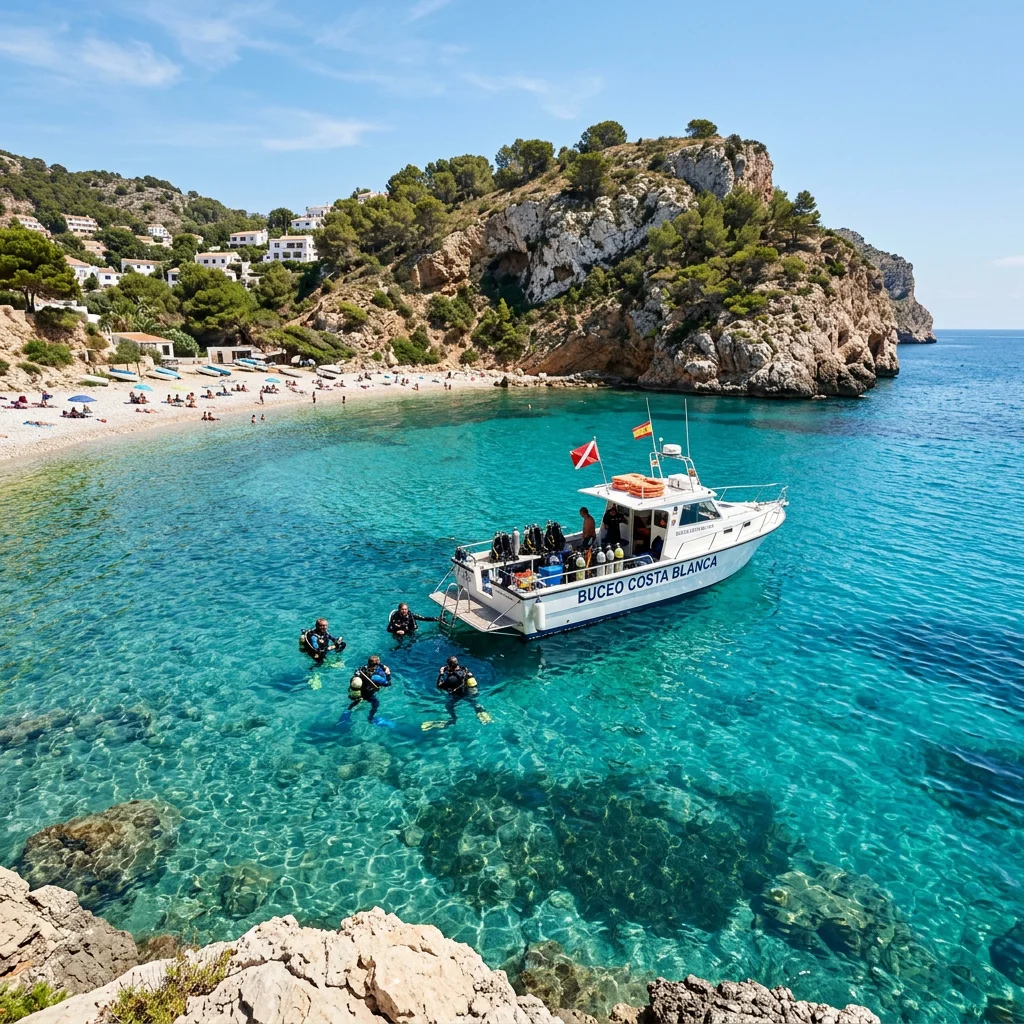
Discover the best diving destinations in Spain, from the crystal-clear waters of the Canary Islands to the Mediterranean of the Medes Islands and Cabo de Palos. More than 1,300 species, pristine marine reserves and temperatures for diving all year round.
Spain is one of the countries with the greatest marine wealth in Europe, and that is no coincidence. With more than 8,000 kilometers of coastline along the Mediterranean, the Atlantic, and the Canarian Indian Ocean, the country offers a variety of underwater landscapes that few nations on the continent can match. From volcanic reefs to posidonia meadows, from historic wrecks to vertical walls covered in gorgonians: diving in Spain is an experience that surprises even the most seasoned divers.
Cabo de Palos and Isla Hormigas, in the Region of Murcia, consistently rank among the best diving destinations in Europe. The Cabo de Palos–Islas Hormigas Marine Reserve protects an ecosystem of extraordinary biological density: large groupers, schools of barracuda, moray eels, and brightly colored sponges populate a seabed that is constantly enriched by the current. The wrecks in the area, including the famous Vapor Sirio, add a historical dimension that no diver should miss.
The Medes Islands, off the coast of L'Estartit in Girona, are perhaps the most recognizable icon of Spanish Mediterranean diving. With more than 1,300 catalogued species, this protected marine reserve is one of the most biodiverse sites in the western Mediterranean. Its caves, tunnels, and walls carpeted with red coral and yellow sponges create a unique visual spectacle. The Costa Brava in general also offers the possibility of diving with underwater maps, a tool that allows divers to navigate and document their dives with precision.
The Canary Islands represent a separate chapter in diving in Spain. The Marine Reserve of La Graciosa and the Northern Islets of Lanzarote, with its impressive 70,000 protected hectares, is the largest marine reserve in Spain and one of the most important in Europe. Its volcanic seabed is home to first-class Atlantic fauna: rays, angel sharks, moray eels, and turtles coexist in an environment of exceptional visibility. Water temperatures, which range between 18°C in winter and 22–24°C in summer, allow comfortable diving year-round.
El Hierro is another Canarian destination that deserves special mention. Declared a UNESCO Biosphere Reserve, the island's Marine Reserve of La Restinga offers near-unique conditions: transparent waters with visibility that can exceed 30 meters, volcanic seabeds with tubular lava formations, and a pelagic fauna that includes manta rays and large pelagic species in season. Tenerife, for its part, combines coastal dives accessible to all levels with legendary wrecks such as the Hermann and the Condesito, while Lanzarote adds the appeal of its underwater volcanic formations and its underwater museum.
The insular Mediterranean does not disappoint either. Ibiza and Formentera have posidonia oceánica meadows declared a World Heritage Site, a key ecosystem that acts as a nursery for species and as the lungs of the Mediterranean. Diving on these islands has a special ecological dimension: each dive is also an opportunity to appreciate the importance of conserving this threatened habitat. Menorca, with its Biosphere Reserve status, offers underwater caves and canyons of great beauty, with well-preserved seabeds thanks to lower tourist pressure.
In the northern Atlantic, the Galician Atlantic Islands — Ons, Sálvora, Cíes, and Cortegada — form a National Marine Park of great ecological value. Galician waters, colder with temperatures around 12–14°C in winter rising to 19–20°C in summer, require appropriate equipment but reward with a very rich marine life: octopuses, spider crabs, conger eels, and an explosion of algae and invertebrates that has no equivalent in the south. The wrecks along the Galician coast, historically marked by storms, add an additional attraction for wreck diving enthusiasts.
Choosing the best diving destination in Spain depends on your level, the time of year, and the type of experience you are looking for. But there is something all these destinations have in common: the possibility of discovering an underwater world that far exceeds expectations.