
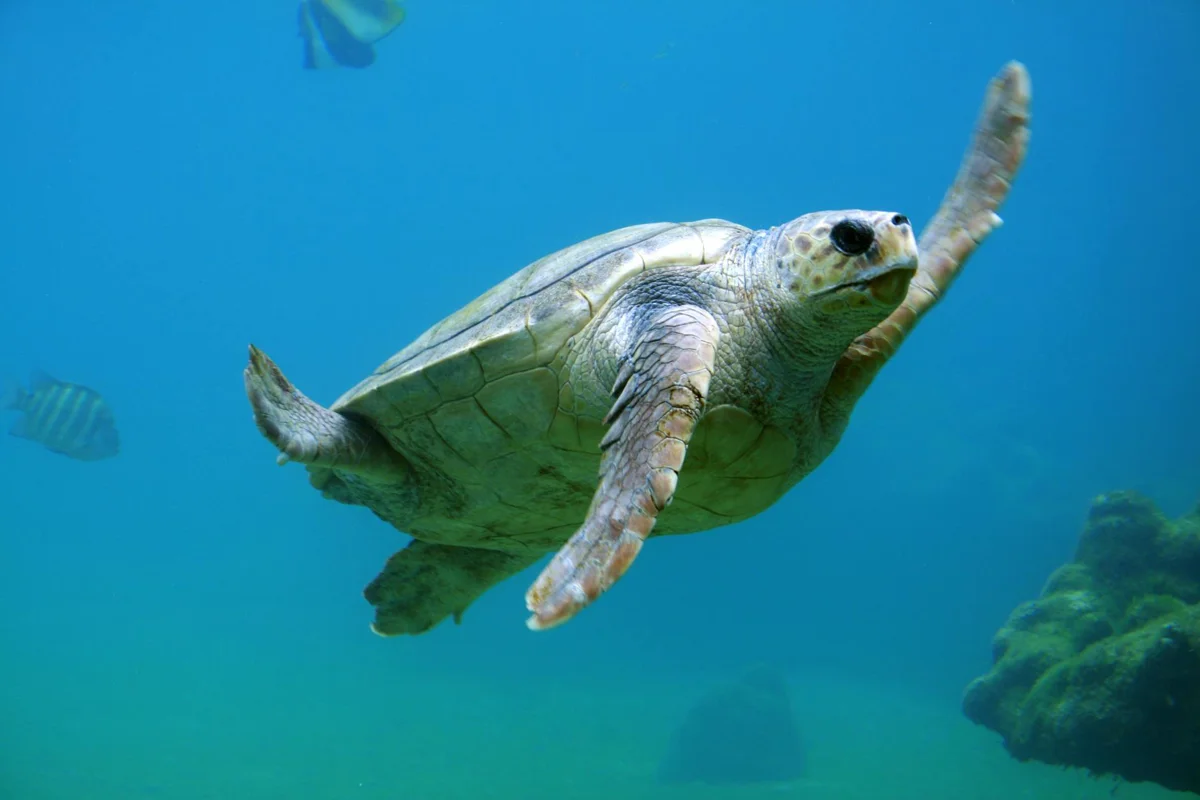
Seven species of sea turtles exist worldwide, every one of them threatened or endangered. For observant divers, being able to identify them sharpens encounters and feeds citizen science. This guide covers the 7 species with their key field marks, core habitats, and where to find them. Knowing a green turtle from a hawksbill from a loggerhead is not academic trivia — it is the foundation of meaningful wildlife observation underwater.
The seven species are: green turtle (*Chelonia mydas*), hawksbill (*Eretmochelys imbricata*), loggerhead (*Caretta caretta*), olive ridley (*Lepidochelys olivacea*), Kemp's ridley (*Lepidochelys kempii*), leatherback (*Dermochelys coriacea*), and flatback (*Natator depressus*). The first six belong to the family Cheloniidae, which means a hard, scuted shell. The leatherback stands alone in Dermochelyidae — its shell is a flexible mosaic of tiny bones covered by thick, leathery skin. Each species occupies a distinct geographic range.
Green turtle (*Chelonia mydas*): the species most divers encounter. Size: 1–1.5 m, weight 100–200 kg. Shell oval, olive-brown. Tropical distribution worldwide. Adults graze almost exclusively on seagrass and algae — the fat turns greenish, hence the name. Best destinations: Hawaii, Galápagos, the Caribbean, Indo-Pacific reefs. If you have ever watched a turtle drift lazily over a meadow of seagrass, it was almost certainly this one.
Hawksbill (*Eretmochelys imbricata*): 60–90 cm, 40–80 kg. Shell plates overlap like roof tiles, in a striking amber-and-brown mosaic. The narrow, pointed beak — shaped exactly like a hawk's — allows it to extract sponges from tight reef crevices. It is the most heavily persecuted species, hunted for centuries for its shell. Best diving destinations: Caribbean, Indo-Pacific, Red Sea. Underwater photographers prize it above all other turtles.
Loggerhead (*Caretta caretta*): 80–100 cm, 100–150 kg. The massive, blocky head — built to crack hard-shelled prey such as conch and crab — is unmistakable. Shell reddish-brown. Found across temperate and tropical waters: Mediterranean, Atlantic, Indo-Pacific. The most commonly sighted turtle in cooler seas. Key sites: Cabrera (Mallorca), Madeira, the coast of Florida, Georgia.
Olive ridley (*Lepidochelys olivacea*): 60–70 cm, 30–45 kg — the smallest sea turtle. Pan-tropical range. Its claim to fame is the *arribada*: tens of thousands of females converge on the same beach on the same night to nest, in one of nature's most astonishing mass-synchrony events (Costa Rica, México, India). Recreational diving encounters are occasional in the eastern Pacific.
Kemp's ridley (*Lepidochelys kempii*): the rarest and most endangered sea turtle. Around 60 cm, 30–45 kg. Range essentially confined to the northwest Atlantic and the Gulf of México. *Arribadas* happen on a single beach in Tamaulipas, México. Sightings during diving are all but impossible outside the nesting beaches. It remains one of the gravest sea turtle conservation concerns on the planet.
Leatherback (*Dermochelys coriacea*): the largest sea turtle — and the largest reptile — alive today. Length 1.8–2.2 m, weight 250–700 kg, with documented individuals reaching 916 kg. No scutes: a smooth black shell studded with white spots covers the back. Diet: almost exclusively jellyfish. Migration range spans from frigid sub-polar waters to tropical nesting beaches. Best sightings: temperate cold waters off western España, Canadá, and the Pacific coast of the USA during migration.
Identifying sea turtles underwater adds a scientific layer to every dive. For underwater photography, all seven species reward patience, but the green turtle and the hawksbill remain the most commonly captured subjects. On the conservation scale, the six Cheloniidae species are globally protected; the leatherback and Kemp's ridley face the most critical pressure. Citizen science apps — TurtleSAT and SWOT — let divers log sightings that feed population research. Every encounter recorded counts.