
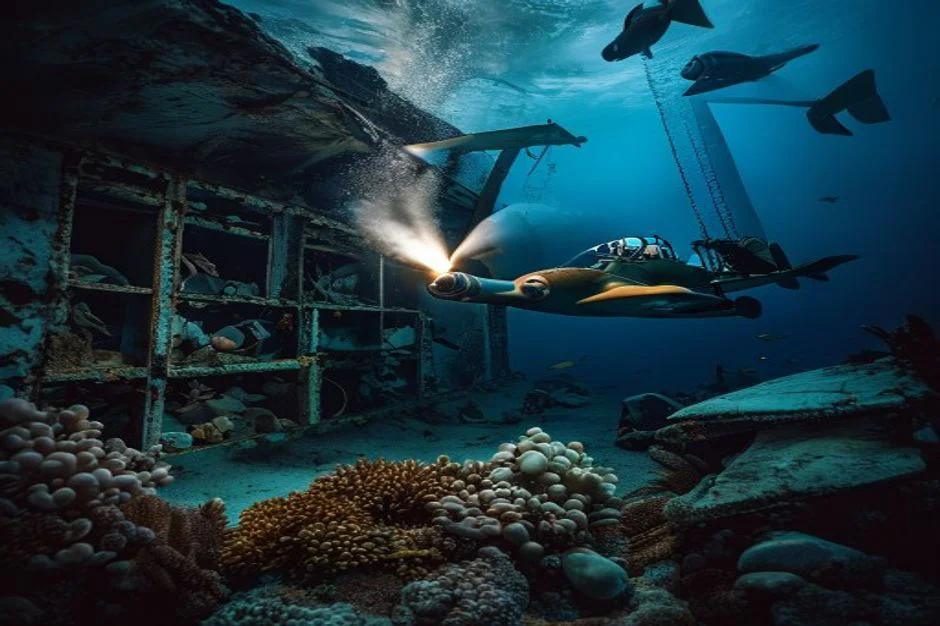
Truk Lagoon — officially Chuuk, in the Federated States of Micronesia — holds what many consider the world's most significant wreck-diving destination. In February 1944, Operation Hailstone sent over 60 vessels and 250 aircraft to the lagoon floor in three days. Eight decades on, those ships remain largely intact, encrusted in coral, and accessible to recreational divers willing to make the journey.
Truk Lagoon sits in the central Pacific, roughly 1,000 km north of Papua New Guinea, within the Federated States of Micronesia. During World War II it served as Japan's principal forward naval base in the Pacific — the equivalent of Pearl Harbor for the Imperial fleet. Between 17 and 18 February 1944, Operation Hailstone, a sustained American carrier air strike, destroyed that base in detail: 60-plus merchant ships, more than 50 warships, 250 aircraft, and thousands of tonnes of ammunition and fuel went to the bottom of the protected lagoon.
The flagship wrecks each have a distinct character. Fujikawa Maru offers cargo holds still packed with Mitsubishi Zero airframes and spare parts. Nippo Maru carries tanks on its upper deck. Sankisan Maru holds railway carriages. Shinkoku Maru, a fleet oiler, is rated by many as the most photogenic wreck in the lagoon for its coral coverage. San Francisco Maru rests at depth with Type 95 tanks still visible. I-169, a Japanese submarine, sits at around 40 m. Depths range from 12 to over 50 m. Most are penetrable with a guide.
First-time visitors are most often struck not by the scale but by the detail. Cargo holds contain complete tanks, disassembled aircraft with Mitsubishi engines and propellers, ammunition crates, gas masks, sake bottles, officers' mess crockery, telegrams, hand tools. Human remains were removed respectfully during the 1970s, but everything else stayed. The result is an underwater military museum with objects in their original positions — a context that purpose-built exhibitions cannot replicate.
Eighty years in tropical water have produced something ecologically complex. Hard and soft corals, sponges, algae and bacterial films now coat every steel surface, turning the wrecks into dense artificial reefs supporting hundreds of species. That is good for marine biodiversity and for the spectacle. It is slower damage for the steel: coral chemistry gradually degrades original structures, and divers who visited in the 1970s and 1980s consistently report that finer details have been lost. The tension between natural colonisation and historical preservation has no clean resolution.
Getting to Chuuk is the first obstacle. United Airlines operates a single weekly connection from Guam, roughly three hours' flight. From Europe that means multiple connections through Estambul or Tokio before reaching Guam — total travel time of 30-plus hours and flights typically costing €2,000-3,000. The established liveaboards — SS Thorfinn, Truk Master, Pacific Master — run 7-to-10-day itineraries at €4,000-6,500 all-inclusive. Budget €6,000-9,500 per person before considering equipment.
The certification baseline is Advanced Open Water plus a wreck specialty and nitrox qualification. The deepest wrecks — San Francisco Maru, I-169 and several destroyers — lie at 50-65 m, requiring at minimum a technical entry-level qualification. Shallower recreational wrecks are accessible with less experience, but 100 logged dives is a practical minimum before the logistics make sense. A powerful primary torch is not optional for penetration dives; a line reel is strongly recommended.
The frustrations are real. Truk is not a flexible destination. One weekly flight, limited shore accommodation, minimal land infrastructure. Liveaboard is the only practical way to reach the full range of sites. December through March offers the flattest seas; the typhoon season from July to October can cancel itineraries with little notice. Operators are experienced but cancellation and rebooking policies vary significantly.
The historical combination on offer here — 60-plus wrecks, largely intact cargo, eight decades of coral growth, and a definitive single historical event as context — does not exist anywhere else in the world. For underwater photographers working wreck subjects, it belongs on the list. For technical divers pushing depth, several sites justify the journey alone. For divers without a specific interest in WWII wreck diving, the cost and logistics demand careful consideration before committing.