
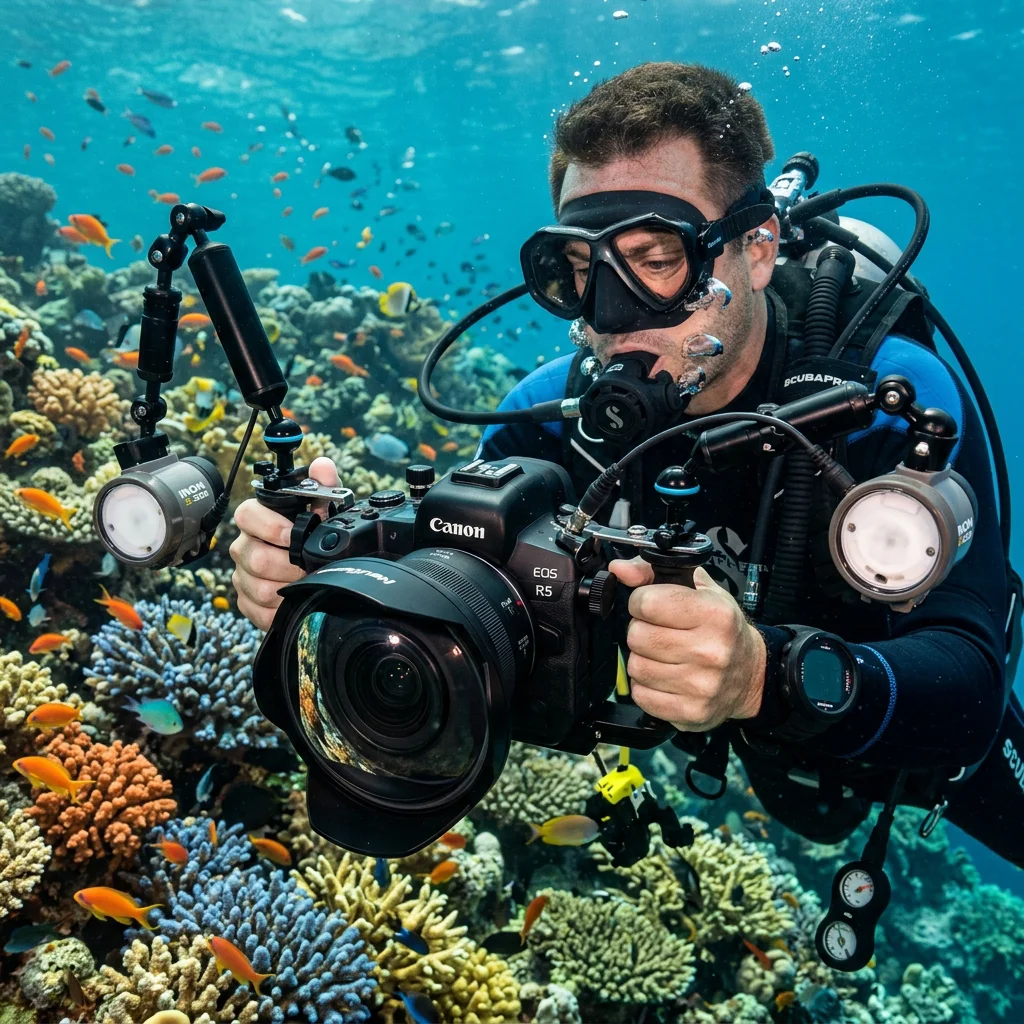
Everything you need to know about underwater photography: from equipment under 500 euros to professional systems, flash lighting techniques, macro settings and tips to improve sharpness.
Underwater photography is one of the most exciting and technically demanding specialties in the world of diving. Combining the skill of controlled buoyancy with the creative eye of a photographer and knowledge of marine behavior is a challenge that hooks you from the first shot. If you have ever come out of the water wishing you could have captured what you saw, the time has come to equip yourself with the right tools.
The good news is that underwater photography has never been more accessible. Action cameras such as GoPro have democratized the discipline, allowing you to carry a rugged device for less than 400 euros. For the next step up, an entry-level compact system can be ready for less than 500 euros. Professional systems with aluminum housings exceed 3,000 euros, but the results are extraordinary.
The greatest optical enemy of the underwater photographer is the absorption of light by water. Reds disappear from about 5 meters, followed by oranges and yellows. The result is images with a blue-green cast. To recover the true colors, a submersible strobe or video light is essential. Lighting the subject at close range produces vibrant images even at 20 or 30 meters.
The distance between the camera and the subject is perhaps the most important rule: the closer you are, the better the result in sharpness, color, and with fewer suspended particles. The general guideline is to stay within one meter. Wide-angle lenses are ideal for seascapes and large animals; macro lenses reveal detail in tiny organisms.
Macro mode opens the door to one of the most fascinating genres: nudibranchs, crustaceans, and tiny fish. Along the Spanish Mediterranean coast it is possible to find dozens of nudibranch species throughout the year. Photographing them with a macro lens and side-mounted strobe can produce images of both scientific and artistic quality at the same time.
Buoyancy is decisive for photographic quality. A diver who cannot control their buoyancy produces blurry images, startled subjects, and damaged reefs. Before investing in photographic equipment, it is highly recommended to have achieved a solid level of control, ideally by completing a Peak Performance Buoyancy course.
Camera settings underwater follow a logic similar to surface photography with some important nuances. A shutter speed of at least 1/125 to freeze movement, aperture set according to the type of image, and the lowest ISO possible to avoid digital noise. Practicing these settings in a pool saves time and frustration.
Starting out in underwater photography is a journey that combines technique, patience, and love for the marine world. You do not need the most expensive equipment: an action camera with good natural light in shallow water can produce spectacular images. What you do need is time underwater, knowledge of the environment, and a desire to improve with every dive.