
Underwater panic is one of the leading causes of fatal diving accidents. Discover how to recognize it, prevent it, and act calmly in risky situations. A comprehensive guide covering safety protocols, expert advice, and lessons from the diving community.
Diving safety is, without doubt, the topic that generates the most debate and reflection within the diving community. In forums, social media groups, and conversations on dive boats, divers share experiences of real incidents, analyze what went wrong, and above all, how to prevent it from happening again. This culture of self-criticism and collective learning is one of the pillars that makes diving a comparatively safe sport, but it also makes clear that risks exist and that ignoring them can cost lives.
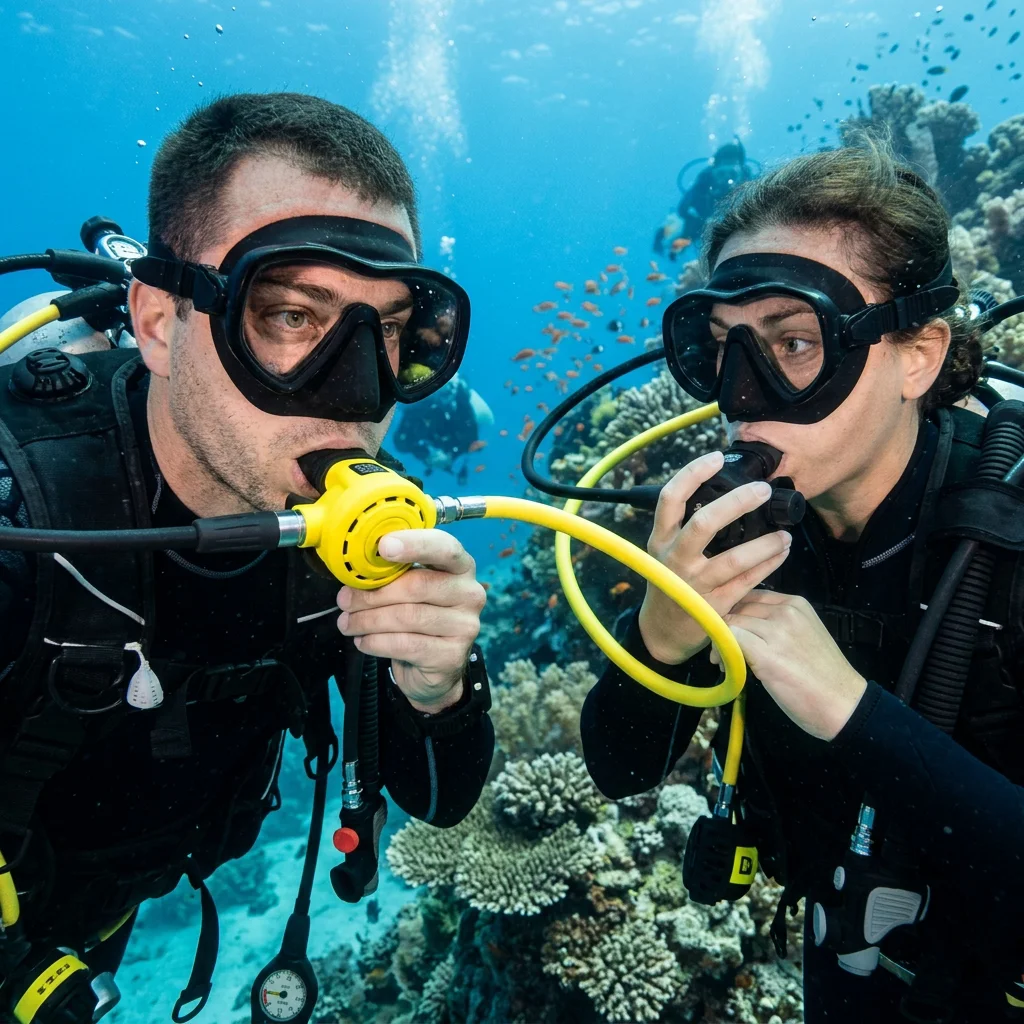
Underwater panic is, by far, the most recurring topic in these conversations. It is not simply a matter of fear: panic in diving is a chain of physiological and psychological responses that can completely override all the training a diver has received. A diver who panics tends to drop the regulator, forgets to inflate the BCD, and attempts to ascend to the surface in an uncontrolled manner. Each of those three mistakes, individually, can be fatal. All three together make up the most common scenario in fatal accidents unrelated to medical causes.
The data backs this reality up powerfully. According to the annual reports of DAN — Divers Alert Network, the world's leading reference organization on diving safety — panic is one of the most frequent triggering factors in diving deaths. Analysis of these reports also reveals that divers who died from non-medical causes were approximately seven times more likely to have committed some violation of recommended practices. This does not mean blaming the victims, but understanding that the accident chain almost always has links that could have been broken.
Faced with this reality, the leading training agencies such as PADI and SSI have incorporated specific stress management modules into their certification programs. These modules teach divers to recognize the early signs of anxiety underwater, to stop and regain control of their breathing, and to act methodically rather than reactively. Mental training is just as important as technical training, and the most experienced instructors insist that calmness is not an innate personality trait but a skill that can and must be trained.
Among the most common bad practices in recreational diving that divers themselves point out, some appear minor but accumulate serious consequences: skipping safety stops, ascending too quickly out of recklessness or running low on air, diving with equipment that has not been properly checked, or overestimating one's own skill level. Safety stops at five meters for three minutes are not an optional suggestion but a protocol that significantly reduces the risk of decompression sickness, especially in divers who accumulate several dives in a single day.
The controversy over solo diving divides the community in an almost irreconcilable way. There are experienced divers who defend the practice with solid arguments: greater concentration, one's own pace, no dependence on a less prepared buddy. But the accident data points in a different direction. Without a buddy present, any minor incident can escalate into an emergency with no possibility of assistance. Most agencies and safety protocols establish the buddy system as a non-negotiable rule, and for very well-founded reasons.
Gas management is another area where the community identifies recurring failures. Returning to the surface with less than 50 bar is not an anecdote to boast about: it is a sign that something in the dive planning went wrong. The rule of thirds — using one third of the air on the way out, another third on the way back, and reserving the last for emergencies — is standard in technical diving and increasingly recommended in recreational diving as well. Managing gas conservatively does not ruin the dive; on the contrary, it allows you to enjoy it with greater peace of mind and a wider safety margin.
Ultimately, diving safety is not the exclusive responsibility of agencies, instructors, or dive centers. It is a shared and, above all, personal responsibility. Every diver must know their own limits, stay fit, update their training regularly, and cultivate the honesty needed to say I don't feel well enough to dive today or this dive is beyond my level. The diving community, when it works well, is a mutual support network where experience is shared without ego and safety is always placed above spectacle.