
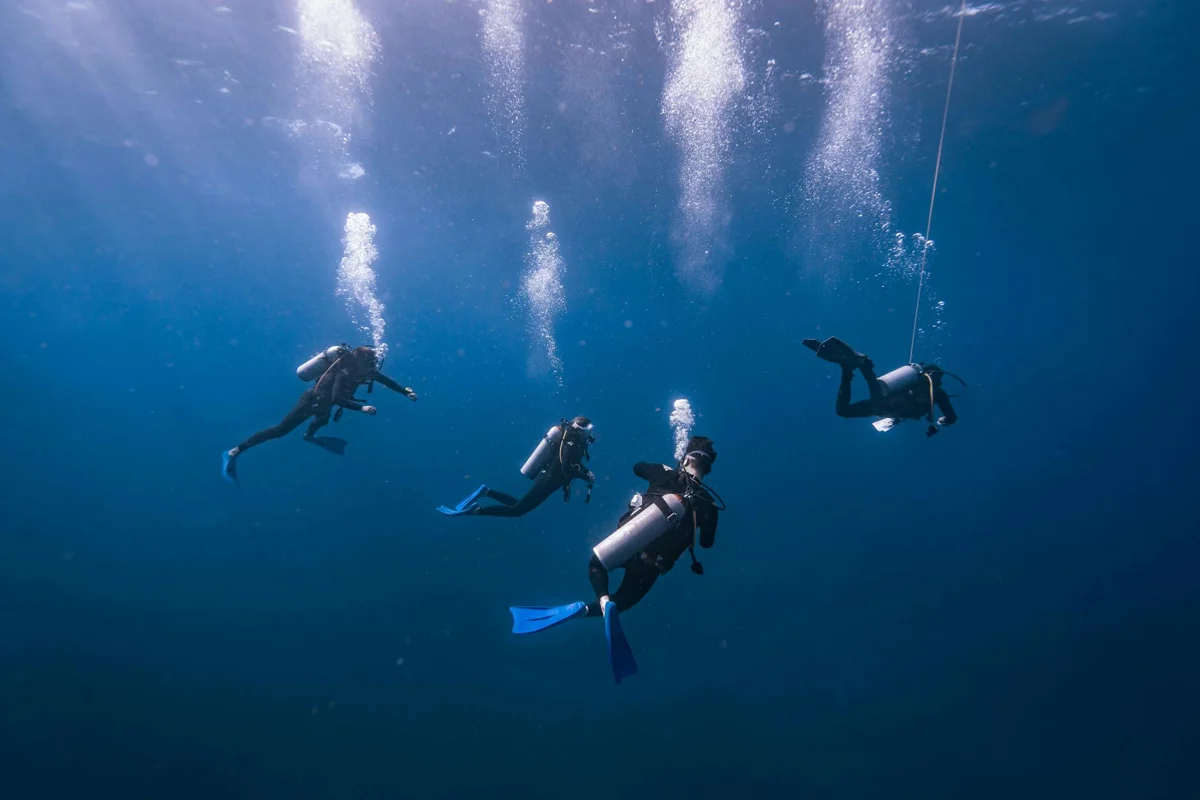
The 3-minute safety stop at 5 metres is one of those protocols almost no one questions and almost no one fully understands. There are divers with 500 dives who still do it out of habit, without knowing exactly what changes in those 180 seconds. Quite a lot, as it turns out — and not what most people assume.
Start with the technical distinction. A 3-minute safety stop at 5 m is not the same as a deco stop. A deco stop is mandatory, calculated by your dive computer based on accumulated bottom time and depth. The safety stop is precautionary, voluntary, and applies even when your computer clears you to ascend directly.
So why bother? Because decompression models — Bühlmann, RGBM, VPM — are probabilistic approximations, not guarantees. They calculate for an average person under average conditions. You are not average: you are a specific person with a specific hydration level, a possible PFO, a certain body composition, an age, a fatigue state. The safety stop covers that margin of error.
What happens physiologically in those 3 minutes is genuinely interesting. At 5 m, ambient pressure is 1.5 bar absolute. Fast tissues — blood, brain — are already nearly fully off-gassed. Slow tissues — fat, joints — are still releasing nitrogen. Those 180 seconds at 1.5 bar let pressure gradients equalise without forming microbubbles in circulation.
Some divers do it at 6 m, others at 4 m, others at exactly 5. It matters relatively little. What matters is that it comes in the last 3 minutes before surfacing, after bottom time — not mid-dive. The function is not decompression, it is stabilisation.
Something most people don't know: if you skip a safety stop on a recreational dive to 30 m for 25 minutes, your DCS risk is still very low — you are within NDL. But if you happen to have an undetected PFO, that is exactly the kind of dive where a microbubble can go systemic. The safety stop reduces that probability considerably. That is why it is done, even though most of us technically don't need it.
Typical mistakes during the stop: drifting up to 3 m due to buoyancy loss, making sudden movements that trigger bubble formation, breathing at 1500 ml per minute instead of staying relaxed, or finishing a cold stop and then bolting to the surface. If you arrive at the stop hypothermic, extend it to 5 minutes. After a deep, exhausting dive, extend it further. It costs nothing and adds real safety margin.
Some argue that a pure O₂ stop at the end accelerates desaturation — true, technical divers do use oxygen-rich gases at the end of deco. In recreational diving the complexity is not worth it. What is worth it is simple: breathe slowly for those 3 minutes. You reduce CO₂ and your body processes residual nitrogen more efficiently. Less chemical turbulence, better off-gassing.
The takeaway after years of diving: the safety stop is one of the few things in this sport that costs almost nothing and gives back a great deal. Three minutes in beautiful light at 5 m, watching pelagic life drift past overhead, is not dead time. The dive is still happening. And just in case, it covers you for the rare situation where your body does not respond the way the tables assume.