
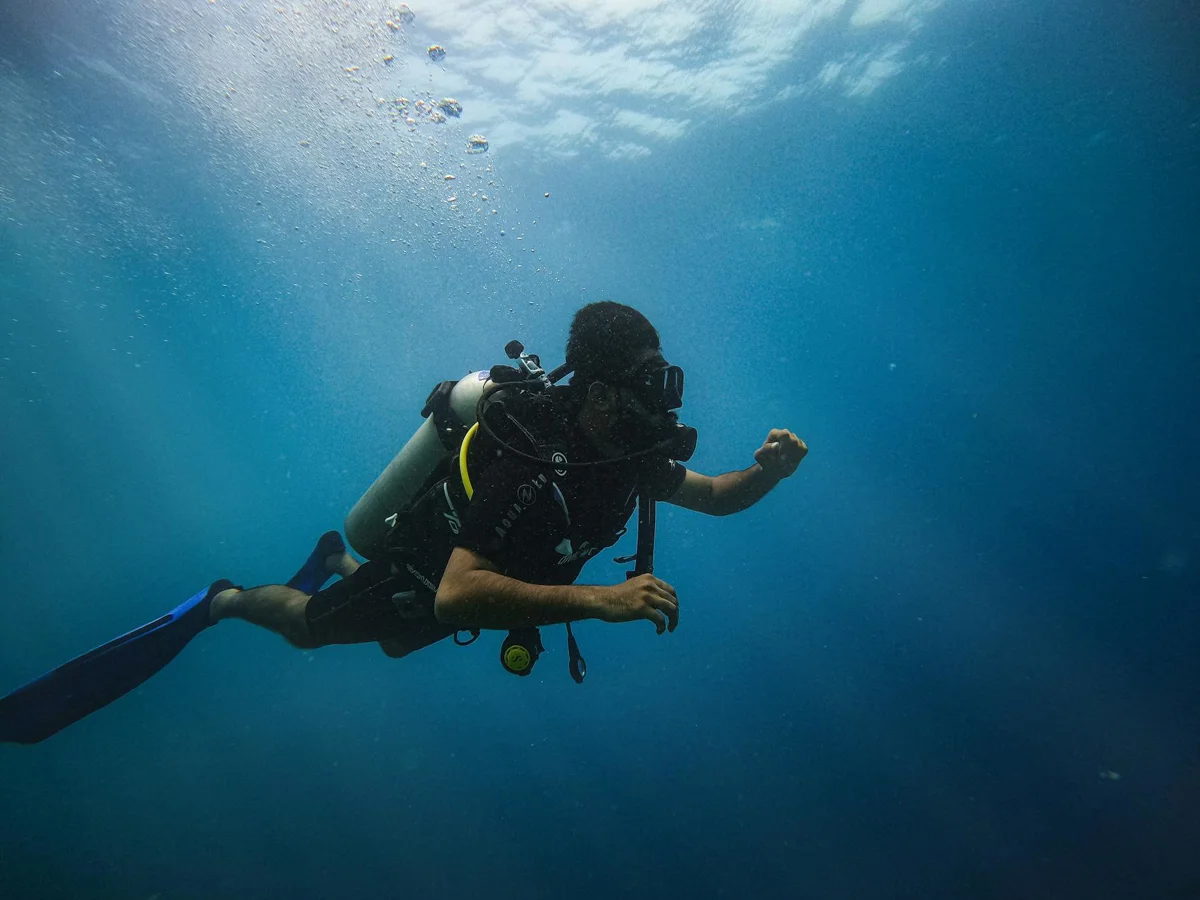
The wing-versus-jacket debate splits recreational and technical divers. Experienced divers favour the wing for horizontal trim and modularity. Beginners do better with a jacket for surface stability. The right choice hinges on dive count and the type of diving you actually do. Neither system is universally superior.
A jacket BCD wraps its air bladder around the diver's torso like a vest. It is the default choice at dive centres worldwide and the standard kit for recreational courses. Upsides: it keeps you comfortably upright at the surface, goes on and off quickly, and packs pockets for accessories. Downside: underwater, the all-around bladder pushes the diver upward when inflated, working against a flat, horizontal trim. Leading models include the Mares Hybrid, Cressi Start Pro, and Scubapro Hydros Pro.
A wing BCD concentrates the entire bladder at the rear, mounted on a metal backplate — steel or aluminium — held in place by a webbing harness. The geometry encourages horizontal trim naturally, weight distribution is more even, and the modular design lets you swap components without replacing the whole system. The trade-off: at the surface, a fully inflated wing rolls you face-down, which is awkward when you are waiting to descend. Setup is more involved, and extracting the benefits takes real practice. Key brands: Halcyon, Hollis, DiveRite, OMS.
Why a newly certified diver should avoid the wing: open-water divers spend a meaningful portion of each dive on the surface — swimming to the entry point, waiting for the group, listening to briefings. A wing inflated at the surface tips you forward. A jacket holds you vertical without effort. For the first 30 to 50 dives, that surface comfort matters more than any trim advantage the wing offers once you descend.
Where the wing earns its place: past 100+ dives, trim control becomes a genuine priority. A tech diver carrying stage tanks or running double cylinders needs sustained horizontal posture to avoid disturbing the bottom, manage gas efficiently, and handle tools. A wing with backplate delivers that posture almost automatically. The modular system also adapts to different configurations — single cylinder, doubles, sidemount — without buying a new BCD.
The transition argument: many advanced divers (200+ dives, advanced open water, wreck, deep) eventually move from jacket to wing. The switch has a learning curve. The first few dives feel unfamiliar; ballast placement and harness fit need recalibrating. Dive centres nearly always stock jackets for rental, so owning a wing means travelling with your own gear or booking centres that accommodate it.
Cost: a quality recreational jacket runs 350–600 €. A wing-and-backplate system costs 600–900 € for the separate components. For a diver logging 30+ dives a year consistently, the additional outlay makes sense given the durability and modularity. For someone diving five to ten times a year on holiday, the jacket is the more rational spend.
Hybrid systems occupy a middle ground: the Scubapro Hydros Pro, Aqualung Outlaw, and Apeks XL4+ blend a rear-biased bladder with enough surface stability to avoid the face-down problem. Trim improves noticeably over a classic jacket without the full commitment to a backplate setup. These are popular with intermediate divers who want better trim but are not yet committed to a technical configuration.
The framework for deciding: jacket for beginners. Jacket or hybrid for advancing recreational divers. Wing with backplate for tech divers and serious wreck divers. Before buying a wing, try one — on a speciality course or through a centre that rents backplate systems. Purchasing a wing before mastering basic trim produces frustration, not improvement.